
Electric Actuator Basics: Understanding Torque, Thrust, and Connection Standards
An electric actuator converts electrical power into the mechanical motion that opens, closes or regulates a valve. For a first-time specifier, the hard part is rarely the concept — it is the vocabulary. Torque, thrust, flange designations, IP codes and frequency ratings appear on every datasheet long before anyone explains what they actually change on site.
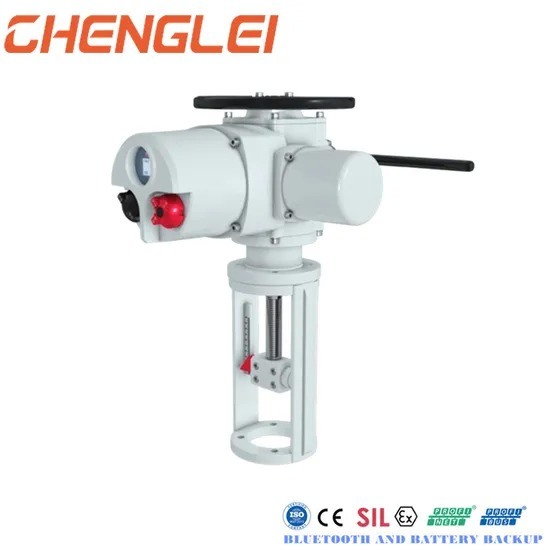
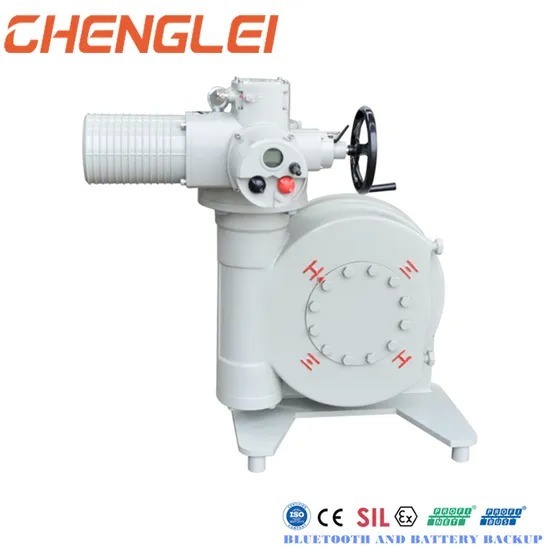
This guide explains those basics in the order a specification is genuinely assembled, using the Chenglei CL range — including the Intelligent Electric Motor Linear Actuator Explosion Proof ZXC Series and model CLZXC4000 from the Intelligent Adjustment Electric Valve Actuator category — as a working example.
Short answer: Torque (N·m) is rotational force, used by part-turn and multi-turn actuators; thrust (N) is linear force, used by straight-stroke actuators. The actuator-to-valve interface follows either a JB2920 Torque Type connection or an ISO5210 (GB/T 12222) Thrust Flange Type connection, and the two are not interchangeable. IP65, IP67 and IP68 describe progressively stronger protection against water ingress. Rated frequency (50/60 Hz) and thermal protection determine how the motor behaves on the project's supply and duty cycle.
Why First-Time Specifications Fail
Most early-stage specification errors are interface errors, not product errors. An actuator that is correctly sized for load can still fail to mount, fail to seal, or fail to run on the supply it was ordered for. Three mismatches account for most of the problem:
- Mounting mismatch. The actuator is bought on torque or thrust alone, while the stem diameter, flange designation and connection type are confirmed after the order. A part-turn valve and a rising-stem valve do not present the same mechanical interface.
- Protection grade chosen by habit. Buyers copy IP67 from a previous project without checking whether the site is a covered plant room, a washdown area, or an open desert installation. Over-specifying adds cost; under-specifying shortens service life.
- Electrical assumptions. Supply voltage, rated frequency and duty cycle are treated as standard, when the motor's behaviour under a specific duty cycle and its thermal protection are part of the selection, not an afterthought.
Resolving these three questions before requesting a quotation is the difference between a specification that can be built and one that has to be reworked.
Industry Background: A Growing, Standardised Category
Electric actuation is a mature category with a documented growth path. Zion Market Research estimates the global electric actuator market at approximately USD 11.5 billion in 2024, projected to grow at a CAGR of 6.5% to 7.2% through 2034. On the demand side, Dataintelo reports that Asia Pacific held 38.5% of electric valve actuator revenue in 2025, valued at over USD 1.8 billion, driven largely by industrialisation in China and India.
Two technical developments shape how buyers now compare products. First, explosion-proof designs are standardised at international level under IEC 60079-0 (general requirements) and IEC 60079-1 (flameproof enclosures 'd'), which gives specifiers a common vocabulary for hazardous-area equipment. Second, intelligent actuation is moving toward Industrial Ethernet protocols such as Profinet and EtherNet/IP, with edge connectivity being discussed for digital-twin integration — a trend that mainly affects how actuators are monitored rather than how they are mounted.
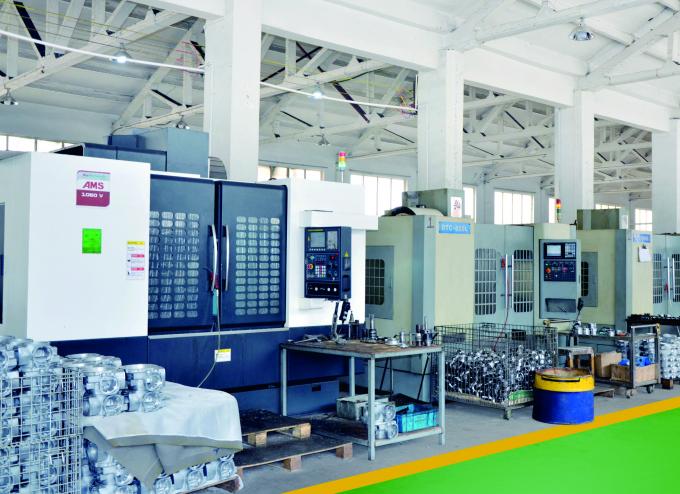
Changzhou Chenglei Valve Technology Co., Ltd. (brand: Chenglei) is one of the manufacturers operating in this category. The company was founded in 2016, works from a 20,000 m² facility with around 100 employees and a 25-engineer R&D team, and produces electric actuators at an annual output of roughly 120,000 units, with about 80% of production exported to global markets. Its CL series actuators are applied across Oil & Gas, Water & Power, and Chemical, Process & Industrial sectors — which is the same set of industries in which the torque, thrust and connection questions below matter most.
Torque and Thrust Are Not the Same Measurement
Torque is the rotational effort an actuator applies to a valve stem, measured in newton-metres (N·m). Thrust is the axial force it applies along a stem, measured in newtons (N). Part-turn actuators and multi-turn actuators are rated in torque; straight-stroke (linear) actuators are rated in thrust.
In the Chenglei range the distinction is visible in the data. Part-turn models run from the QI10 at 100 N·m with a 0.06 kW motor up to the QI500 at 5000 N·m with a 0.55 kW motor and an explosion-proof housing. Multi-turn models include the Z5 at 50 N·m, the Z10 and Z30 at 100 N·m and 300 N·m, and the Z45 at 450 N·m. Straight-stroke models are specified differently: the ZXC linear actuator listing gives a maximum thrust of 10000 N with a standard stroke of 250 mm.
Two practical consequences follow from this. First, a torque figure cannot be substituted for a thrust figure when the valve is a linear-stroke design, and vice versa — the units and the loading direction are different. Second, when a buyer asks for a price on a model number alone, the most common missing inputs are the required torque or thrust and the stem diameter. Supplying both shortens the quotation cycle considerably.
Connection Standards: JB2920 Torque Type vs ISO5210 (GB/T 12222) Thrust Flange
The connection between actuator and valve is where torque or thrust is transferred, and the Chenglei data lists two connection types on the same product family: JB2920 Torque Type or ISO5210 (GB/T 12222) Thrust Flange Type. The naming describes what each joint is built to carry.
A JB2920 Torque Type connection is a torque-carrying interface: the joint is designed around rotational transmission between the actuator output and the valve stem. An ISO5210 (GB/T 12222) Thrust Flange Type connection is a flange interface that also carries the axial thrust a rising-stem valve feeds back into the actuator. Choosing between them starts with one question: does the valve impose axial force on the actuator, or does it primarily rotate?
The second group of numbers to confirm is mechanical, and it appears directly in the product data. Flange designations and maximum stem diameters vary by model size, which is why the flange cannot be assumed from the torque rating alone.
| Model | Actuator type | Nominal torque | Max. stem diameter | Flange no. |
|---|---|---|---|---|
| QI10 | Part-turn, intelligent, OEM | 100 N·m | 19 mm | F05/F07 |
| QI15 | Part-turn, IP67 | 150 N·m | 19 mm | F05/F07 |
| QI60 | Part-turn, 0.18 kW | 600 N·m | 38 mm | F10/F12 |
| QI500 | Part-turn, explosion-proof housing | 5000 N·m | 55 mm | F14/F16 |
| Z10 | Multi-turn (on-off / IP67 variants) | 100 N·m | 28 mm | F10 |
| Z30 | Multi-turn, explosion-proof, IP67 | 300 N·m | 40 mm | F14 |
| Z45 | Multi-turn, explosion-proof, IP67 | 450 N·m | 48 mm | F16 |
Note that a flange designation and a stem diameter are a pair: the same F10 flange appears on models with different torque ratings, so the mounting drawing — not the model number — confirms fit. For rotary applications, a separate standard applies: the ZXC Type Electric Rotary Actuator listing states ISO 5211 mounting with travel angles of 90°, 120° and 180°, which is the part-turn counterpart to the thrust flange convention used on multi-turn and linear units.
IP65, IP67, IP68: What the Numbers Actually Promise
IP codes have two digits: the first covers solids, the second covers water. A first digit of 6 means the enclosure is dust-tight. The second digit is where the practical differences between IP65, IP67 and IP68 sit.
| Protection grade | Water protection (second digit) | Where it is normally appropriate |
|---|---|---|
| IP65 | Protected against water jets | Covered plant areas, hose-down zones, dusty indoor installations |
| IP67 | Protected against temporary immersion | Outdoor mounting, washdown bays, areas exposed to pooling water |
| IP68 | Protected against continuous immersion | Permanently submerged or flood-prone locations, subject to the manufacturer's stated conditions |
The Chenglei range lists these grades pragmatically. The ZXC linear actuator and the CLZXC4000 configuration are listed at IP65/67; the intelligent on-off and explosion-proof models list IP65/IP67/IP68 as available options; the explosion-proof DQ series lists IP65/IP67/IP68 alongside NEMA 4/4X/7&9 enclosure types for buyers working to North American conventions. The grade is therefore a configuration choice, not a fixed property of a model line.
One caution for first-time specifiers: IP68 is not a single number. Immersion depth and duration are stated by the manufacturer rather than fixed by the code, so the condition of use should be confirmed in writing rather than assumed from the rating alone.
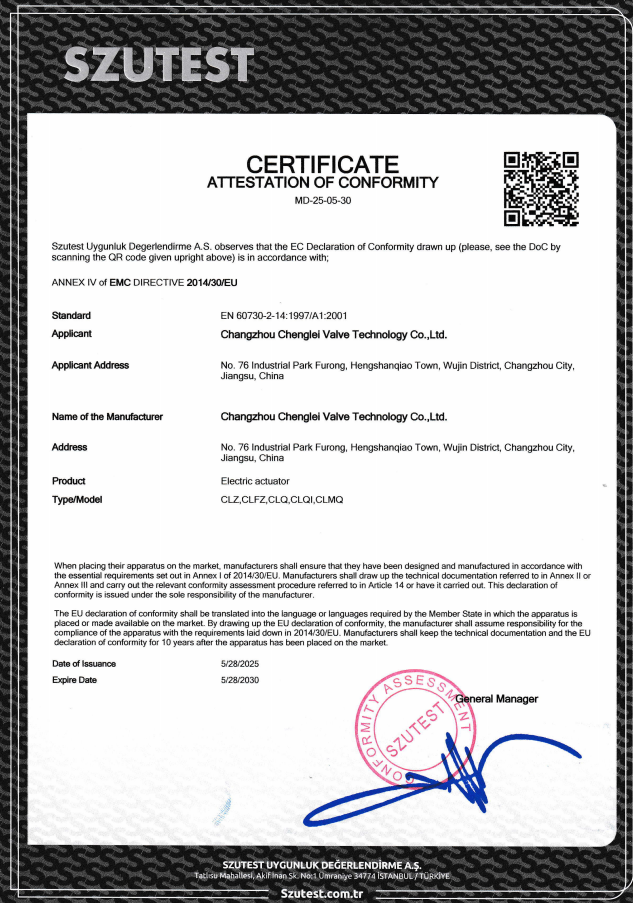
On the compliance side, the Chenglei electric actuator range holds CE certification to standard EN 60730-2-14:1997/A1:2001, issued on 2025-05-28 and valid through 2030-05-28 for the EU market. Explosion-proof models are listed with ATEX / Exd BT4 / CT4 markings. Internationally, hazardous-area equipment is standardised under IEC 60079-0 and IEC 60079-1, and the required gas group and temperature class — IIA, IIB or IIC, and T1 to T6 — is set by the area classification rather than by the actuator supplier.
Rated Frequency, Duty Cycle and Thermal Protection
These three items sit in the electrical column of the datasheet, which is why they are the ones most often skipped. They matter because they decide whether the motor can do the job repeatedly without overheating.
Rated frequency. Chenglei's CL-series models are listed as rated for 50/60 Hz, with supply options covering 380V, 110V, 220V, 440V and 660V AC, or 12V/24V DC. A dual-frequency rating means the same product family can be applied to projects on either supply convention, which simplifies spares for buyers who operate in more than one market. Where valve stroke timing is critical, the resulting operating speed should be confirmed with the manufacturer for the specific supply rather than assumed from the nameplate.
Duty cycle. The intelligent on-off and explosion-proof models list motor duty as S2 10 min, 15 min or 30 min, or S1/S3/S4/S6 at 24% or 40%. The Chenglei ZXC linear actuators and the CLZXC4000 configuration list a working system of 10 minutes for short time. A duty rating describes how long the motor may run within a given cycle — it is the number that decides whether a valve can be stroked frequently or only occasionally.
Thermal protection. Thermal protection is listed as fitted on the intelligent multi-turn, explosion-proof and ZXC linear models. In practice it is the safeguard that keeps the motor winding from being damaged when a duty cycle, an ambient temperature or a jammed valve pushes the motor beyond its design envelope. It is a selection item to verify, not an optional extra to assume.
Related ratings worth confirming at the same time: insulation class F, an environmental temperature range of -20 to +60 °C on the CLZXC4000 configuration (special orders covering -60 to +70 °C), relative humidity of up to 95% at +25 °C, and an anti-corrosion coating described as high-temperature baking paint.
Step-by-Step: How to Specify an Electric Actuator
The sequence below follows the order of the questions above and can be used as a checklist when preparing an enquiry.
- Establish the valve's demand. For part-turn and quarter-turn valves, take the required nominal torque in N·m. For linear and rising-stem valves, take the required thrust in N and the stroke. Record the stem diameter in both cases.
- Match the mounting interface. Decide between a JB2920 Torque Type connection and an ISO5210 (GB/T 12222) Thrust Flange Type connection, then confirm the flange designation (for example F05/F07, F10/F12, F14/F16) against the valve drawing. For part-turn rotary units, ISO 5211 mounting applies.
- Set the protection grade from the site, not from habit. Choose IP65, IP67 or IP68 according to jet exposure and immersion risk; use NEMA 4/4X/7&9 equivalents where the project is specified in North American terms.
- Confirm the power supply and rated frequency. Check the available AC or DC supply and whether the site runs at 50 Hz or 60 Hz; confirm the resulting operating speed where stroke timing matters.
- Define the duty cycle and verify thermal protection. State how often the valve strokes and for how long; select S2 or S1/S3/S4/S6 duty accordingly and confirm thermal protection is fitted.
- Choose the control mode and feedback. On-off or modulating, with 4-20 mA signal input on the intelligent and explosion-proof listings, and position feedback options such as 4-20 mA or 0-10 VDC on the rotary range.
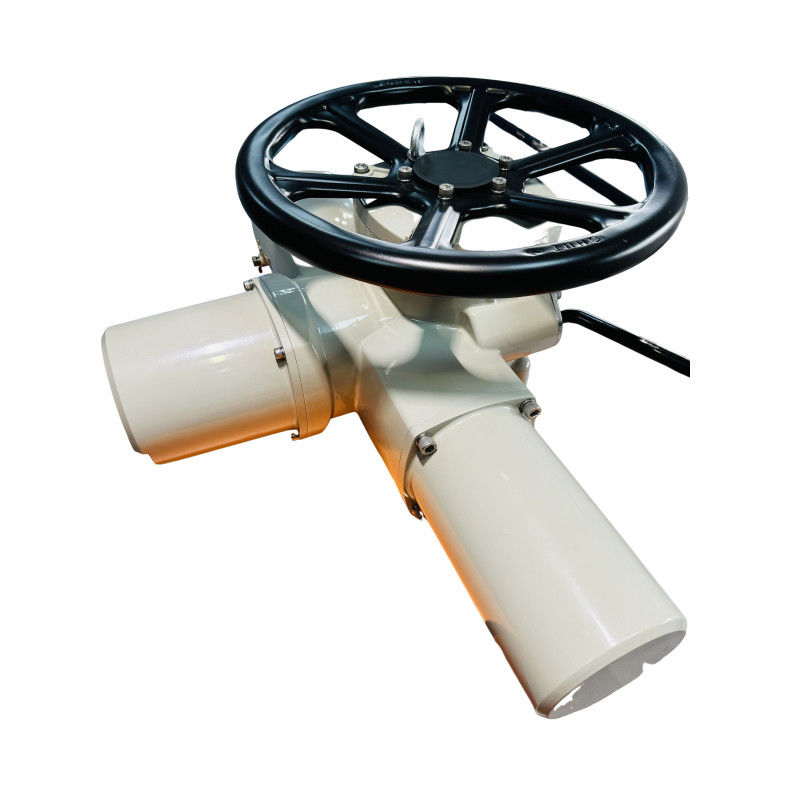
- Confirm manual override and optional functions. Handwheel override is listed across the range; battery backup and Bluetooth connection are listed on selected intelligent and linear models.
- Validate through documentation and a sample. Request the certification set for the target market, confirm acceptance criteria, and test a single unit against the actual valve before committing to volume.
Steps 2 and 5 are the ones buyers most often return to, because they depend on the valve and the process rather than on the actuator catalogue. Where a project needs a change to a standard configuration, Chenglei's production services cover both OEM (Original Equipment Manufacturer) and ODM (Original Design Manufacturer) modes, with customization available on voltage and logo.
How These Basics Play Out in Real Projects
Specification theory is easiest to check against field conditions, because the same basics produce different configurations in different environments.
Desert oil valve project — Iraq
A petroleum engineering client in Iraq deployed electric actuators on large-scale oil valve projects in a desert environment with high corrosion from salt spray and hydrogen sulphide, plus high ambient temperature. The configuration used a C5-M grade anti-corrosion coating exceeding conventional standards, combined with double-sealed wiring to isolate corrosive gases and moisture. The application has been running for six years and the client has been a repeat petroleum engineering customer.
Remote pipeline control — Russia
A Russian strategic partner in oil, natural gas and energy infrastructure used more than 400 high-end intelligent electric actuators for remote automated control of pipelines and energy infrastructure, where the ambient temperature reaches minus 40 °C and potentially explosive gas environments apply. The units passed EX explosion-proof certification and were verified for extreme operating conditions, addressing low-temperature failure modes such as LCD failure, lubricant solidification and material brittleness. The relationship has run for four years.
High-vibration processing plant — United States
A large non-ferrous metal group in the United States applied intelligent electric actuators to automatic valve control in core sections including raw material grinding, high-temperature digestion, sedimentation separation and evaporation stations, where strong vibration and high temperature were present. The design response was a separation of the mechanical body from the control unit, keeping the precision control section away from the vibration source and simplifying maintenance at height. This is a clear example of the protection-and-mounting discussion being extended into mechanical design, rather than solved by an IP rating alone.
Frequently Asked Questions
What certifications and protection ratings should an electric actuator carry for hazardous or outdoor projects?
For the Chenglei electric actuator range, CE certification covers standard EN 60730-2-14:1997/A1:2001, issued 2025-05-28 and valid to 2030-05-28 for the EU market, and explosion-proof models are listed with ATEX / Exd BT4 / CT4 markings alongside protection grades of IP65, IP67 or IP68. Hazardous-area equipment is standardised internationally under IEC 60079-0 and IEC 60079-1, and the area classification — gas group IIA, IIB or IIC, and temperature class T1 to T6 — determines which marking is acceptable. The correct approach is to match the marking to the classification before ordering, not after.
Can the actuator be customized for our voltage or branded with our logo?
Yes. Chenglei provides both OEM and ODM production services, and the listed customization options are voltage and logo. Supply options across the range cover 380V, 110V, 220V, 440V and 660V AC, or 12V/24V DC, with rated frequency of 50 Hz or 60 Hz, so a non-standard supply requirement can be addressed at the configuration stage rather than through a separate product line.
What determines the price of an electric actuator, and what commercial terms apply?
Chenglei quotes price as negotiable per configuration, so the quotation follows the specification rather than a published list. Within the CL range, what changes between models is nominal torque (from 100 N·m on the QI10 to 5000 N·m on the QI500), motor power, protection grade, whether an explosion-proof housing is used, and which intelligent functions are included — those variables, not the model family, drive the number. Commercial terms are MOQ of 1 set, delivery terms FOB or CIF, and payment by L/C, T/T or PayPal.
Can we validate a sample before committing to volume?
Yes. The minimum order quantity is 1 set, every unit is 100% tested, and the acceptance criteria are based on pre-shipment test. A buyer can therefore order a single actuator, mount it on the actual valve, and verify torque or thrust, mounting fit and control signal behaviour before scaling to a full project order.
What is the lead time and production capacity once a configuration is agreed?
Lead time is 10-15 working days for orders of 1 to 100 units; above 100 units it is negotiated per order. Monthly production capacity is 8,000 units, supported by annual output of roughly 120,000 units, and after-sales service is handled through remote support. Buyers who want the complete parameter set before specifying can download the Chenglei product brochure from the link below, and configuration questions can be confirmed directly with the Chenglei team via WhatsApp (+86 134 0132 5958) or email (terry.gui@cz-chenglei.com).
Conclusion
Electric actuator specification comes down to four questions asked in the right order: how much torque or thrust the valve needs, which connection standard the valve interface follows, how much ingress protection the site demands, and what the supply and duty cycle allow. Torque and thrust are different measurements and are not interchangeable; JB2920 Torque Type and ISO5210 (GB/T 12222) Thrust Flange Type connections serve different loading directions; IP65, IP67 and IP68 describe progressively stronger water protection that should be selected from site conditions; and rated frequency, duty cycle and thermal protection determine whether the motor survives the way it is used.
Answer those four questions first, and the remaining variables — flange designation, stem diameter, control mode, feedback signal, manual override and certification set — become confirmation steps rather than risks.
Next Step: Check the Basics Against a Real Configuration
Download the Chenglei product brochure for the full parameter set, or send your valve data — required torque or thrust, stem diameter, flange designation, supply voltage and frequency, and area classification — and the Chenglei team will confirm a configuration for your project.
Download the Chenglei Electric Actuator Brochure (PDF)
Website: www.electricvalvesactuators.com
WhatsApp / Phone: +86 134 0132 5958 | Email: terry.gui@cz-chenglei.com
Have Questions or Need More Details?
Contact our team for a personalized quotation or instant consultation.
Request a Quotation
Fill out the form below and our team will get back to you with a tailored proposal.
WhatsApp Direct Chat
Prefer to chat in real-time? Message us on WhatsApp for instant assistance & quick answers.
- Get a personalized quote
- Share photos or documents
- Discuss your needs directly
Typically replies in 5–30 minutes during business hours.