
Electric Actuator Selection for Ball Valves in Oil & Gas: A Field Guide
Electric Actuator Selection for Ball Valves in Oil & Gas: A Field Guide
Automating a ball valve on an oil and gas site is a constraint-matching exercise, not a catalog exercise. The actuator has to deliver enough torque to unseat and reseat the ball, bolt to the valve stem through a defined interface, run on the power the site actually supplies, carry an explosion-proof marking that matches the hazardous area classification, and still be operable by hand when the line is remote and the power is down.
Short answer: six specifications decide whether an electric actuator will work on an oil and gas ball valve — rated torque against the valve’s break torque, connection type (JB2920 torque type or ISO 5210 thrust flange type), power supply (AC or 12 V / 24 V DC), control mode (intelligent on-off or intelligent modulating), explosion-proof and enclosure classification (ATEX / Exd BT4/CT4, IP65/IP67/IP68), and manual override (handwheel). An actuator can match the flange and still fail the project if any one of these six is wrong.
Reference data in this guide comes from the published product, certification and project records of Changzhou Chenglei Valve Technology Co., Ltd. (“Chenglei”) — a valve electric actuator manufacturer based in Changzhou, Jiangsu, China — together with third-party market and standards data, which is attributed at the point of use. Chenglei was founded in 2016, operates a 20,000 m² facility with roughly 100 employees and 25 engineers, and states an annual output of 120,000 units with about 80% of production exported to global markets. Its CL series valve electric actuators are used in Oil & Gas, Water & Power, and Chemical, Process & Industrial applications, and its company profile records two decades of developing and manufacturing valve electric actuators.
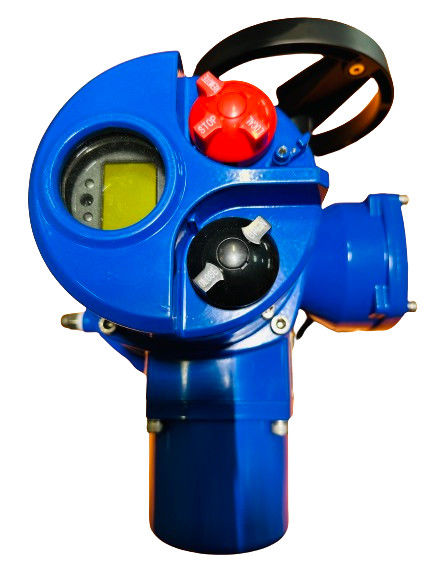
Cover: explosion-proof quarter-turn electric actuator used for ball valve automation in oil, gas and process service.
Problem Definition: Why Ball Valve Actuation in Oil & Gas Is a Constraints Problem
A ball valve is a quarter-turn device, and the selection problem starts with its torque curve rather than with its size. Required actuator torque is highest at two moments: when the ball breaks away from the seat (break-to-open torque) and when it re-seats against the seal. Running torque between those two moments is lower. An electric actuator sized against running torque will pass a bench test and stall on site. The sizing rule is therefore to select against the worst-case torque of the valve, not the average.
The second constraint is the mechanical interface. Ball valve stems are connected to actuators in one of two ways: a torque type connection (Chenglei datasheets specify JB2920 torque type) or a thrust flange interface (ISO 5210, referenced in Chenglei data as ISO5210 / GB/T 12222 thrust flange type). Ball valves transmit torque, not thrust, so the torque type interface is the normal match; using a thrust flange configuration on a torque-driven quarter-turn valve introduces backlash and mounting stress that no amount of torque margin will compensate for.
The third constraint is the electrical area classification. In a hydrocarbon plant the actuator is not a generic electric motor — it becomes a piece of explosion-proof equipment whose marking must match the zone it is installed in. For oil and gas, Chenglei’s application records specify explosion-proof (Ex d IIB T4) construction with IP65/IP67 protection as the baseline requirement for valve and pipeline control duties.
The fourth constraint is operability. Unmanned metering stations, remote pipeline block valves and desert well pads share the same requirement: when power or signal is lost, someone has to be able to stroke the valve. That makes manual override — the handwheel — a functional requirement, not an accessory.
Designing these four constraints out early is cheaper than correcting them after factory acceptance testing. The rest of this guide turns them into a selection sequence.
Industry Background: A Market Moving Toward Certified, Intelligent Units
The scale of the equipment category explains why specification discipline matters. Zion Market Research estimates the global electric actuator market at approximately USD 11.5 billion in 2024, with projected growth of 6.5% to 7.2% CAGR through 2034. Dataintelo recorded Asia-Pacific as the largest regional block in 2025 with a 38.5% revenue share of the electric valve actuator market, valued at over USD 1.8 billion, driven by industrialization in China and India. China’s export position in the component supply chain is equally visible: the Observatory of Economic Complexity (OEC) reported USD 6.43 billion in Chinese electric motor part exports in 2024, equal to 26.1% of global exports in that category.
On the standards side, explosion-proof actuators are standardized under IEC 60079-0 (General Requirements) and IEC 60079-1 (Flameproof Enclosures “d”). Within that framework, explosion-proof equipment is classified into gas groups (IIA, IIB, IIC) and temperature classes (T1–T6), with Group IIC required for hydrogen environments. This is why two actuators can both be described as “explosion proof” and still not be interchangeable: the marking has to cover the gas group and temperature class of the specific installation.
The practical consequence for buyers is that specification language is now the differentiator. A purchase requisition that says only “explosion-proof electric actuator” leaves the gas group, temperature class, enclosure rating, connection type and duty cycle undefined — all of which are documented parameters on the datasheets discussed below.
The Solution Set: Matching Actuator Data to Ball Valve Requirements
Chenglei builds its actuator range around three mechanical duty families — part-turn (quarter-turn), multi-turn, and intelligent linear/straight-stroke — plus a dedicated low-temperature explosion-proof series. For ball valve work in oil and gas, the part-turn family is the primary match, while the intelligent series carries the modulating and diagnostic functionality that modern control systems expect.
1. Torque class and connection type
The part-turn QI family covers a wide torque span with published data down to individual model numbers. The QI10 is rated at 100 N·m nominal torque with a 0.06 kW motor, 0.4 A rated current, 1 r/min output rotation speed, F05/F07 flange, 19 mm maximum stem diameter, 8.6 kg reference weight and a 60:1 manual speed ratio. The QI15 steps to 150 N·m with a 0.075 kW motor and 0.5 A rated current on the same F05/F07 flange. The QI60 reaches 600 N·m with a 0.18 kW motor, F10/F12 flange, 38 mm maximum stem diameter, 21 kg reference weight and an 87:1 manual speed ratio. At the top of the quarter-turn range, the QI500 delivers 5000 N·m at 0.5 r/min with a 0.55 kW motor, 2.5 A rated current, F14/F16 flange, 55 mm maximum stem diameter, 35 kg reference weight, a 348:1 manual speed ratio and an explosion-proof housing.
Where Chenglei publishes the interface set, it is stated as: connection type JB2920 torque type or ISO5210 (GB/T 12222) thrust flange type. That single line is the one to quote in a requisition, because it removes the ambiguity between a torque interface and a thrust interface before drawings are issued.
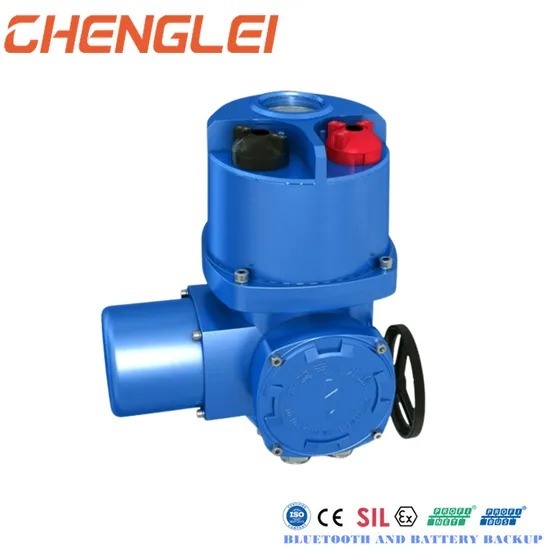
A 24 V DC quarter-turn electric valve actuator offering a JB2920 torque type connection or an ISO5210 thrust flange connection, on-off or modulating control, and a handwheel manual override.
2. Low-voltage DC and power supply options
Site power is rarely negotiable. Chenglei’s published voltage range is 380 V / 110 V / 220 V / 440 V / 660 V AC or 12 V / 24 V DC at 50 Hz / 60 Hz rated frequency, with F-class insulation. Low-voltage DC matters most where the actuator sits on a solar or battery-backed remote installation, or where the control cabinet already distributes 24 V DC to field instruments. The Intelligent 24 V DC JB2920 / ISO5210 flange quarter-turn actuator is the clearest example of that configuration: 24 V DC supply, high torque, quarter-turn output, on-off or modulating control, thermal protection, battery backup and Bluetooth connectivity.
For linear and straight-stroke duty, the intelligent ZXC platform is published with a 24 V DC supply, 220 V / 380 V 50 Hz power supply option, a maximum thrust of 10,000 N, a 250 mm standard stroke with a 100 mm stroke variant, built-in limit switches, IP65 rating, thermal protection, battery backup, Bluetooth connection and explosion-proof construction. The CLZXC4000 is the reference model in that family, listed as an intelligent adjustment electric valve actuator with 50/60 Hz rated frequency, IP65/IP67 protection, a working temperature of −20 to +60 °C, high-temperature baking paint anti-corrosion coating and a 10-minute short-time working system.
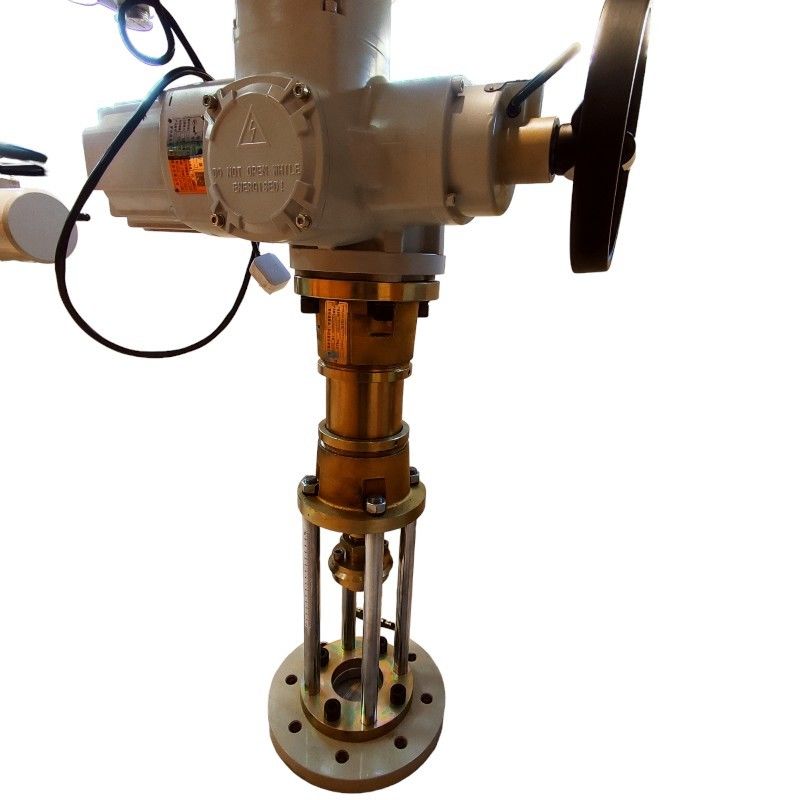
The intelligent electric motor linear actuator explosion-proof ZXC series, referenced by model CLZXC4000, supports 24 V DC supply and explosion-proof construction.
3. Control mode: intelligent on-off versus intelligent modulating
Ball valves in oil and gas fall into two control groups. Block and isolation valves need on-off operation; pressure, flow and level control loops need modulating action. Chenglei documents both control methods on the same platform: control method on-off or modulating, with 4–20 mA signal input and position feedback of 4–20 mA or 0–10 V DC on the rotary variant.
Motor duty is stated as S2 10 min, 15 min or 30 min, or S1 / S3 / S4 / S6 at 24% and 40% duty. That distinction is directly linked to valve behaviour — a short-time-duty actuator suits a periodically cycled block valve, while a modulating loop needs the appropriate duty rating declared in the purchase specification. Intelligent functions published on these units include thermal protection, built-in limit switches, battery backup and Bluetooth connection for local configuration.
4. Explosion-proof and enclosure ratings
Chenglei datasheets state explosion-proof compliance as ATEX / Exd BT4/CT4, with protection grades of IP65 / IP67 / IP68, NEMA 4 / 4X / 7&9 enclosure types on the explosion-proof DQ series, an ambient range of −20 to +60 °C in standard configuration (special orders −60 to +70 °C) and relative humidity tolerance of ≤95% at +25 °C. Body material options are aluminium alloy, stainless steel or carbon steel.
Alignment with the international framework matters here: IEC 60079-0 and IEC 60079-1 define the flameproof enclosure approach, and the gas group / temperature class marking is what makes the certificate applicable to a specific zone. A BT4 or CT4 designation is only meaningful when read together with the gas group and the ambient range of the installation.
Certification documentation is also published. The Intelligent Electric Motor Linear Actuator Explosion Proof ZXC Series holds CE certification for the EU market, issued by szutest under standard EN 60730-2-14:1997/A1:2001, with an issue date of 28 May 2025 and an expiry date of 28 May 2030. The ZXC type electric rotary actuator datasheet lists CE, ATEX and SIL3 in its certification field.
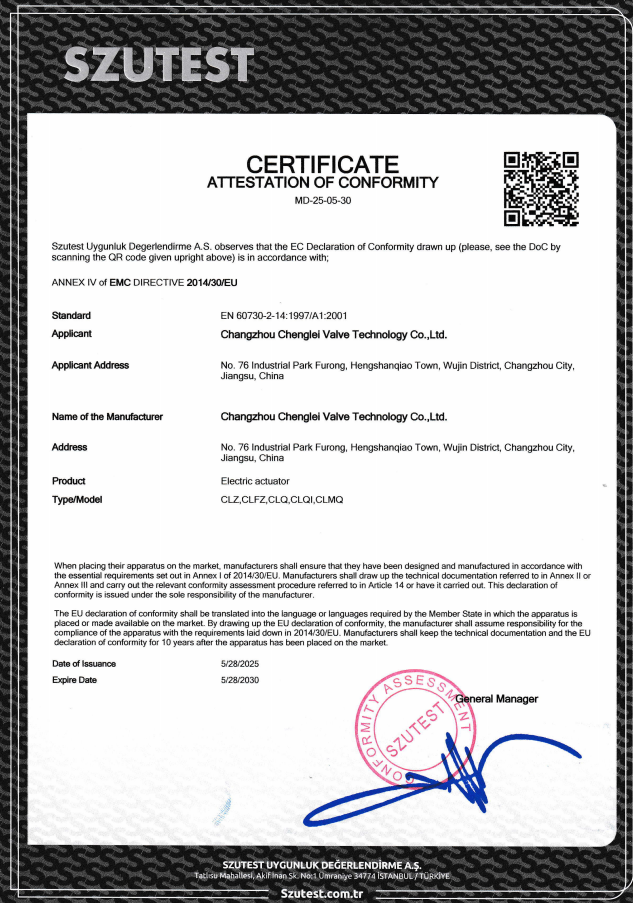
CE certification documentation for the Intelligent Electric Motor Linear Actuator Explosion Proof ZXC Series, issued by szutest under EN 60730-2-14:1997/A1:2001 for the EU market.
5. Manual override for remote locations
Manual override appears explicitly in the datasheets: manual override is listed as “Yes, with handwheel,” and the rotary variant lists a handwheel or lever. The gearing behind that handwheel is published per model, and it determines how much physical effort an operator needs. The QI10 and QI15 use a 60:1 manual speed ratio, the QI60 uses 87:1, the QI500 uses 348:1, and the Z series multi-turn actuators are listed at a 1:1 manual speed ratio. For a remote block valve on a pipeline, the manual speed ratio is worth checking against the response time the operating procedure requires — a higher ratio reduces effort but lengthens the manual stroke.
6. Manufacturing and order data that supports the specification
Behind the datasheet, Chenglei records a monthly manufacturing capacity of 8,000 units, OEM / ODM production with voltage and logo customization, a minimum order quantity of 1 set, 100% testing of production, and after-sales remote support. Product-level data lists a supply ability of 3,000 sets per month per model, with packaging in carton or wooden box, and production in Changzhou, Jiangsu, China. These are the figures a procurement team needs when it has to confirm that a specified actuator can actually be delivered against a project schedule.
Step-by-Step: A Seven-Step Selection Breakdown
The following sequence converts a valve data sheet and an area classification drawing into a purchase specification. Each step ends with the data point that must appear in the requisition.
- Confirm the hazardous area classification. Establish the zone, gas group and temperature class, then write the required marking (for example ATEX / Exd BT4 or CT4) and the enclosure rating (IP65, IP67 or IP68) into the specification. Chenglei’s oil and gas application data uses explosion-proof Ex d IIB T4 with IP65/IP67 as the baseline, and IEC 60079-0 / IEC 60079-1 define the underlying standard framework.
- Establish the required torque. Obtain the valve manufacturer’s break-to-open and seating torque, apply the project safety factor, and select against the worst case. Match that figure to a published nominal torque — for example 100 N·m (QI10), 150 N·m (QI15), 600 N·m (QI60) or 5000 N·m (QI500) in the part-turn range.
- Fix the connection type. Decide between the JB2920 torque type connection and the ISO5210 (GB/T 12222) thrust flange type, and record the flange standard (F05/F07, F10/F12, F14/F16) and maximum stem diameter (19 mm to 55 mm across the QI range).
- Match the power supply. Choose from 380 V / 110 V / 220 V / 440 V / 660 V AC or 12 V / 24 V DC at 50/60 Hz. Where the site is remote and DC-powered, specify the 24 V DC configuration explicitly.
- Select the control mode and feedback. Specify on-off or modulating, the signal input (4–20 mA) and the position feedback type (4–20 mA or 0–10 V DC). Confirm whether thermal protection, battery backup and Bluetooth configuration are required.
- Confirm enclosure, duty cycle and environment. Check protection grade, motor duty (S2 10/15/30 min or S1/S3/S4/S6 at 24%/40%), ambient temperature range (−20 to +60 °C standard, −60 to +70 °C special order) and the anti-corrosion coating requirement. For coastal or desert service, note the high-temperature baking paint coating used on the ZXC platform and the C5-M grade coating documented in Chenglei’s Middle East project record.
- Confirm manual override and order details. Specify the handwheel manual override and review the manual speed ratio (60:1, 87:1, 348:1 or 1:1 depending on model). Then confirm order quantity against lead time: 1–100 units are quoted at 10–15 working days, quantities above 100 are negotiated, MOQ is 1 set, and packaging is carton or wooden box.
Use Cases: How Specified Actuators Performed in the Field
Three documented projects show how the constraint logic above translates into delivered equipment.
Iraq — large-scale oil valve project, 200 sets. A petroleum engineering company in Iraq required actuators for a large oil valve project in a desert environment with high corrosion (salt spray and hydrogen sulphide) and high temperature, placing extreme demands on protection level and service life. Chenglei won the bid and supplied 200 sets; the project has been running for six years. The engineering response was a C5-M grade anti-corrosion coating that exceeds conventional standards, combined with double-sealed wiring technology to isolate corrosive gases and moisture intrusion in open-air sulphur-containing environments. The stated outcome was stable oilfield production and reduced maintenance downtime caused by leaks.
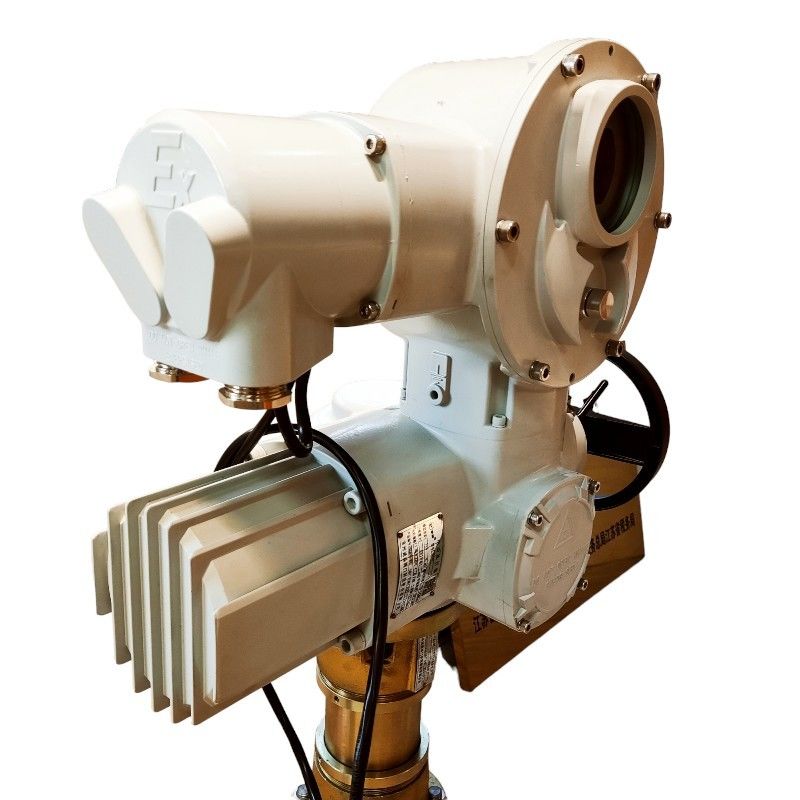
Explosion-proof industrial electric rotary actuator of the type deployed in high-corrosion, high-temperature oil field service.
Russia — oil, gas and energy infrastructure partner, 400 sets. A Russian strategic partner in oil, natural gas and energy infrastructure needed remote automated control of local pipelines in extremely cold conditions with large temperature swings and potentially explosive gas environments. The first batch of over 400 high-end intelligent electric actuators passed the factory acceptance test (FAT) conducted by the Russian delegation, and the deployment replaced some traditional European and American brands in that application. The technical highlights recorded were EX explosion-proof certification and verified starting and precise control at minus 40 °C, addressing low-temperature failure modes such as LCD failure, lubricant solidification and material brittleness. Chenglei lists this as a four-year project relationship.
United States — large non-ferrous metal group, 200 sets over six years. In alumina production, valves in raw material grinding, high-temperature digestion, sedimentation and evaporation stations operate under strong vibration, high temperature and dust. Chenglei supplied actuators into a deployment of nearly a thousand intelligent units, using Profinet industrial Ethernet communication across the plant, and adopted a design that separates the mechanical body from the control unit so precision control parts sit away from the vibration source — also simplifying maintenance at height.
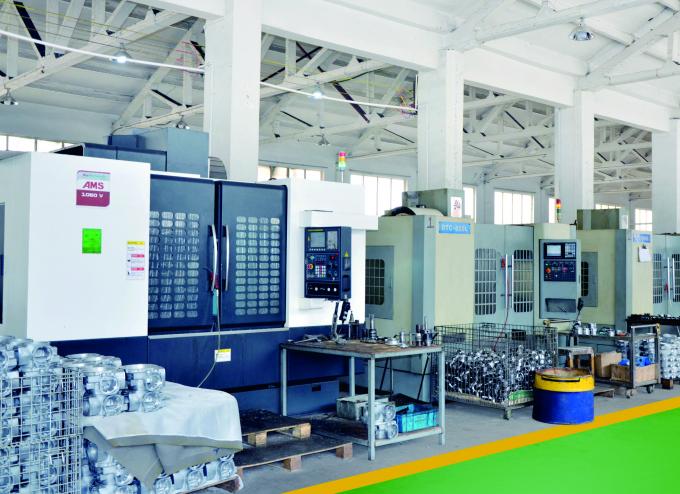
Production workshop: actuator assembly and 100% testing are carried out in Chenglei’s Changzhou facility.
Comparison Table: Actuator Series for Ball Valve and Related Valve Duty
The table below compares the Chenglei series that most often appear in oil and gas valve specifications. Every figure is taken from published product data; where a datasheet extract does not state a parameter, the cell says so rather than estimating.
| Series | Typical duty | Example models | Rated torque / thrust | Mounting and connection | Power supply and control | Explosion-proof / enclosure |
|---|---|---|---|---|---|---|
| QI part-turn (quarter-turn) | Ball and butterfly valve automation; isolation and modulating service | QI10, QI15, QI60, QI500 | 100 N·m, 150 N·m, 600 N·m, 5000 N·m; 1 r/min (QI10–QI60), 0.5 r/min (QI500) | F05/F07, F10/F12, F14/F16 flanges; max stem diameter 19–55 mm | 220 V nominal on the QI10 part-turn datasheet; on-off control | QI500 supplied with explosion-proof housing |
| Z multi-turn | Multi-turn valve duty | Z5, Z10, Z30, Z45 | 50 N·m, 100 N·m, 300 N·m, 450 N·m; 18/24 r/min output | F10, F14, F16 flanges; max stem diameter 28–48 mm | 0.12–1.1 kW motor power; on-off control | Z10 and Z30 variants offered as IP67 explosion-proof actuators |
| ZXC intelligent linear / straight-stroke | Intelligent adjustment and linear stroke duty (CLZXC4000 reference model) | CLZXC4000, CLZXC40000 | Max thrust 10,000 N; 250 mm standard stroke, 100 mm stroke variant | ISO 5211 mounting on the rotary variant; flange connection | 24 V DC; 220 V / 380 V 50 Hz; on-off or modulating; 4–20 mA input, 4–20 mA or 0–10 V DC feedback | CE certified (EN 60730-2-14:1997/A1:2001); IP65/IP67 |
| DQ explosion-proof, low temperature | High-speed, low-temperature explosion-proof duty | DQ Series | Not stated in the available datasheet extract | Flange connection | 380/110/220/440/660 V AC or 12/24 V DC; on-off or modulating; 4–20 mA signal input | ATEX / Exd BT4/CT4; IP65/IP67/IP68; NEMA 4/4X/7&9; −60 to +70 °C |
Read the table as a filter, not a ranking. If the valve is a quarter-turn ball valve with a torque-type stem connection, the QI row is the starting point. If the line needs a modulating stroke rather than a 90° rotation, the intelligent ZXC platform is the relevant column. If the site temperature drops far below the standard −20 °C floor, the DQ series is the one whose datasheet explicitly declares operation from −60 °C.
FAQ
What explosion-proof certification should an electric actuator carry for an oil and gas ball valve?
Chenglei datasheets state explosion-proof compliance as ATEX / Exd BT4/CT4, alongside protection grades of IP65 / IP67 / IP68 and NEMA 4 / 4X / 7&9 enclosure types on the DQ series. For oil and gas valve and pipeline control, Chenglei’s application data specifies explosion-proof Ex d IIB T4 with IP65/IP67 protection. The underlying standards are IEC 60079-0 (General Requirements) and IEC 60079-1 (Flameproof Enclosures “d”), with equipment classified by gas group (IIA, IIB, IIC) and temperature class (T1–T6); Group IIC is required for hydrogen environments. Separately, the Intelligent Electric Motor Linear Actuator Explosion Proof ZXC Series holds CE certification issued by szutest for the EU market under standard EN 60730-2-14:1997/A1:2001, valid from 28 May 2025 to 28 May 2030.
Can one actuator platform handle both on-off and modulating ball valve duty?
Yes, where the datasheet declares both. Chenglei publishes control method as on-off or modulating, with 4–20 mA signal input and position feedback of 4–20 mA or 0–10 V DC on the rotary variant. Motor duty is declared as S2 10 min, 15 min or 30 min, or S1 / S3 / S4 / S6 at 24% and 40%, so a modulating loop and a periodically cycled block valve can be specified on the same platform with different duty ratings. Intelligent functions available across the range include thermal protection, built-in limit switches, battery backup and Bluetooth connection, and the company offers OEM / ODM production with voltage and logo customization.
What actually drives the price of an explosion-proof electric actuator?
Chenglei lists price as negotiable, so there is no published price band to quote — the commercial figure is set per configuration. The variables that move it are documented in the datasheets: torque class (from the 100 N·m QI10 to the 5000 N·m QI500), whether an explosion-proof housing is required, protection grade (IP65 versus IP67 or IP68), control mode (on-off versus modulating with 4–20 mA feedback), body material (aluminium alloy, stainless steel or carbon steel), anti-corrosion coating and environmental range, and optional functions such as battery backup and Bluetooth. Any comparison should therefore be made on an identical specification line rather than on a headline model number.
Can we validate a unit before committing to a bulk order?
Yes. Chenglei’s capability data states a minimum order quantity of 1 set and 100% testing of production, which allows a single unit to be ordered, inspected and functionally tested before a project quantity is released. For larger programmes, the Russia case record shows a delegation conducting a factory acceptance test (FAT) on a first batch of over 400 intelligent electric actuators before wider deployment — a workable model for buyers who want documented verification ahead of full release.
What are the lead time and supply capacity?
Chenglei data states a lead time of 10–15 working days for orders of 1–100 units, with quantities above 100 quoted on a negotiated basis. Product-level data lists a supply ability of 3,000 sets per month per model, while the company’s manufacturing capability record states a monthly capacity of 8,000 units, with annual output of 120,000 units; packaging is carton or wooden box and production is in Changzhou, Jiangsu, China. Buyers can review the complete specification set in the Chenglei product catalogue (PDF) before finalising a requisition.
Conclusion: Write the Constraints Before You Write the Model Number
Selecting an electric actuator for a ball valve in oil and gas is decided by six documented parameters: torque margin against break-to-open torque, connection type (JB2920 torque type or ISO5210 thrust flange type), supply voltage (AC or 12 V / 24 V DC), control mode (on-off or modulating with 4–20 mA feedback), explosion-proof and enclosure classification (ATEX / Exd BT4/CT4, IP65/IP67/IP68), and manual override via handwheel for remote sites. When those six lines are written into the requisition first, model selection becomes a lookup rather than a negotiation — and the field records from Iraq, Russia and the United States show what happens when they are respected.
Next step: send the valve data sheet and area classification together with your torque and interface requirements, and Chenglei will confirm the matching part-turn, multi-turn or intelligent linear configuration, including 24 V DC options, explosion-proof marking and handwheel override.
Contact: Mr. GUI JING · WhatsApp / Phone: +8613401325958 · Email: terry.gui@cz-chenglei.com
Website: www.electricvalvesactuators.com
Address: Building A5, Intelligent Equipment Industrial Park, Hengshanqiao Town, Economic Development Zone, Changzhou City, China
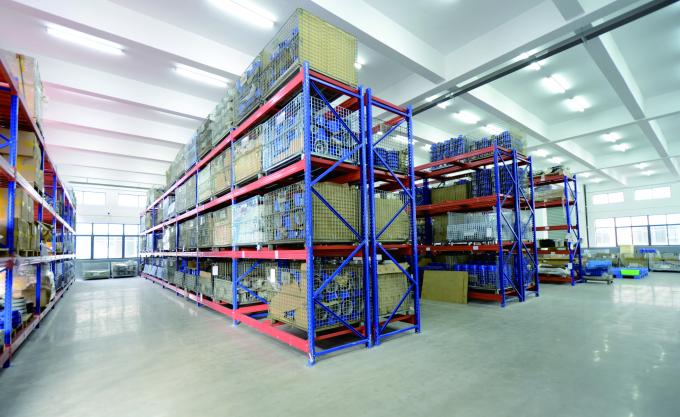
Finished electric actuators staged in the warehouse before shipment; packaging is carton or wooden box.
Have Questions or Need More Details?
Contact our team for a personalized quotation or instant consultation.
Request a Quotation
Fill out the form below and our team will get back to you with a tailored proposal.
WhatsApp Direct Chat
Prefer to chat in real-time? Message us on WhatsApp for instant assistance & quick answers.
- Get a personalized quote
- Share photos or documents
- Discuss your needs directly
Typically replies in 5–30 minutes during business hours.