
How to Select Electric Actuator Connection: JB2920 Torque vs ISO5210 Thrust Flange
Choosing an electric actuator connection is a mechanical decision made against a load path, not a catalogue preference. The two interfaces offered on Chenglei valve electric actuators — the JB2920 torque type and the ISO5210 (GB/T 12222) thrust flange type — are designed to transfer different forces, and swapping one for the other after delivery is rarely possible without changing the valve, the mounting kit or both.
Short answer: use a JB2920 torque-type connection when the valve only requires rotational torque to be transmitted and reacted at the mounting flange, and use an ISO5210 (GB/T 12222) thrust-flange connection when the actuator must also absorb axial thrust generated by the valve stem. Confirm the governing load, the flange pattern (F05/F07 through F14/F16), the stem diameter, and the control duty before ordering.
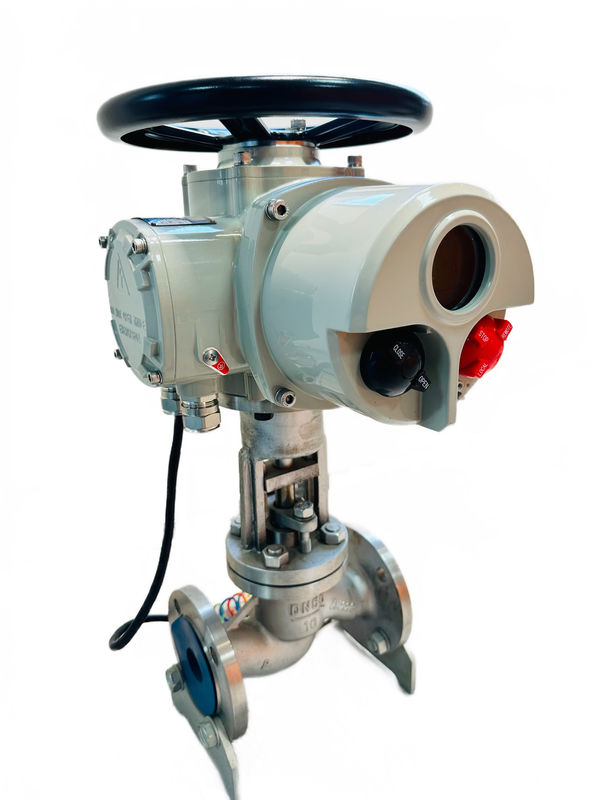
Problem Definition: Why Connection Choice Fails Late
Connection selection is normally the last line completed on an actuator datasheet and the first line inspected on site. Two failure patterns are common.
The first is a torque-only interface applied where axial thrust exists. The valve stem pushes against the actuator output instead of rotating it, and the thrust load is transferred into gearing and bearings that were never dimensioned for it. The second is a heavy thrust-flange assembly specified where only torque is produced. This adds unnecessary mounting height, complicates alignment, and consumes envelope space in a valve pit or skid without adding functional value.
Both errors share a cause: the connection is chosen from a photo or a model number rather than from the load the interface must carry. The corrective step is to define the load direction first, then the interface, then the actuator model.
Industry Background: Why Interface Discipline Matters More Now
The global electric actuator market was estimated at approximately USD 11.5 billion in 2024, with projected growth of 6.5% to 7.2% CAGR through 2034 (Zion Market Research). Asia Pacific dominated the electric valve actuator market with a 38.5% revenue share in 2025, valued at over USD 1.8 billion, driven by industrialisation in China and India (Dataintelo). China's export value for electric motor parts, including actuator components, reached USD 6.43 billion in 2024, representing 26.1% of global exports (Observatory of Economic Complexity).
Three consequences follow for buyers evaluating a connection.
- Cross-standard sourcing is now normal. A valve made to one regional standard is frequently fitted with an actuator sourced from another supply chain, so the buyer — not the manufacturer — must verify that the flange pattern and stem interface actually match.
- Hazardous-area documentation is a separate axis. Explosion-proof electric actuators are standardised under IEC 60079-0 (General Requirements) and IEC 60079-1 (Flameproof Enclosures 'd'), with gas groups IIA, IIB and IIC and temperature classes T1–T6; Group IIC is required for hydrogen environments. The mechanical connection does not change the certification, but an incorrectly fitted interface can stress an enclosure and its cable entries.
- Digital control is pulling duty cycles upward. Intelligent electric actuators are seeing a shift toward Industrial Ethernet protocols such as Profinet and EtherNet/IP and edge connectivity for digital twin integration (IndexBox). More position changes per hour means the stem interface is loaded more often, not more heavily — which changes what to inspect.
Chenglei (Changzhou Chenglei Valve Technology Co., Ltd.) manufactures valve electric actuators in Changzhou, Jiangsu, China, in a 20,000 m² facility with an annual output of 120,000 units and a 25-engineer R&D team. Products are applied in Oil & Gas, Water & Power, and Chemical, Process & Industrial sectors, with an 80% export ratio across global markets.
The Two Connection Types, Explained by Load Path
JB2920 torque type: transmitting rotation
A torque-type connection transfers the actuator's output rotation to the valve stem. The reaction to that torque is absorbed by the actuator mounting flange and the valve yoke. The interface therefore has to resist torsional load, maintain concentricity between the actuator output and the stem, and hold the coupling rigid under repeated cycling.
On Chenglei part-turn models, this is the dominant interface. Nominal torque and flange data across the range show how the interface scales with load:
- QI10 — 100 N·m nominal torque, F05/F07 flange, max stem diameter 19 mm, 1 r/min output rotation speed.
- QI15 — 150 N·m nominal torque, F05/F07 flange, max stem diameter 19 mm.
- QI60 — 600 N·m nominal torque, F10/F12 flange, max stem diameter 38 mm.
- QI500 — 5,000 N·m nominal torque, F14/F16 flange, max stem diameter 55 mm, explosion-proof housing.
As stem diameter and flange size increase, the connection is transferring a larger torque through a larger mechanical interface. That relationship, rather than the model number alone, is what a buyer should read from a datasheet.
ISO5210 (GB/T 12222) thrust flange type: absorbing thrust and torque
A thrust-flange connection is specified when the valve imposes an axial load on the actuator in addition to rotational load. Chenglei lists the connection type for its intelligent electric valve actuator as “JB2920 Torque Type or ISO5210 (GB/T 12222) Thrust Flange Type” — the two interfaces are offered on the same electrical platform, which makes the choice purely mechanical.
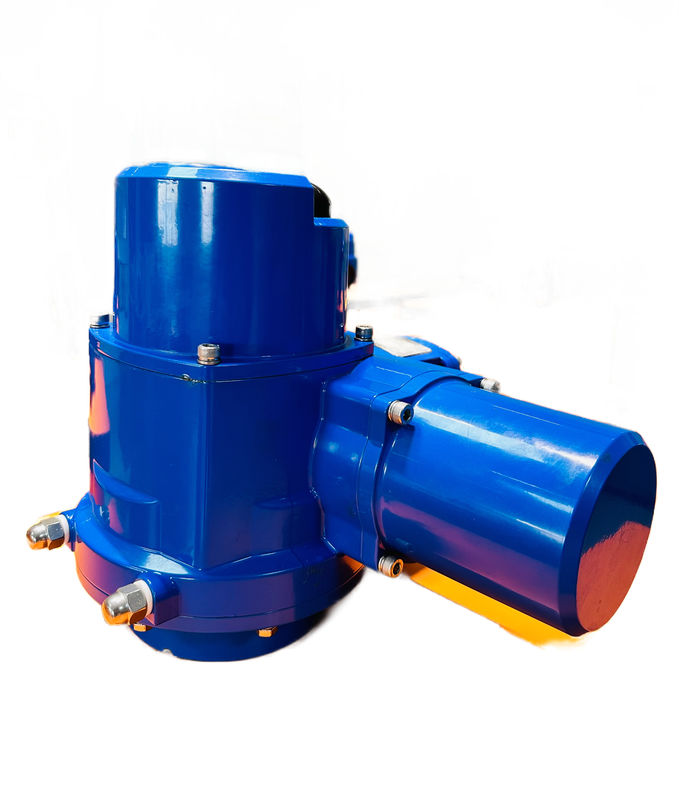
Thrust-flange applications in the Chenglei range include the multi-turn and linear families:
- Z5 — 50 N·m nominal torque, F10 flange, max stem diameter 28 mm, 18/24 r/min.
- Z10 — 100 N·m nominal torque, F10 flange, max stem diameter 28 mm, 18/24 r/min; available as an ODM multi-turn actuator and as an IP67 explosion-proof multi-turn actuator with thermal protection.
- Z30 — 300 N·m nominal torque, F14 flange, max stem diameter 40 mm.
- Z45 — 450 N·m nominal torque, F16 flange, max stem diameter 48 mm, 24 r/min.
- ZXC linear series — max thrust 10,000 N, standard stroke 250 mm, stroke length 100 mm, 24 VDC, IP65, thermal protection, explosion-proof, battery backup and Bluetooth connection. The CLZXC4000 model is rated IP65/67, operates from -20°C to +60°C, uses a high-temperature baking paint anti-corrosion coating, and is specified for 10 minutes short-time working.
Decision rule: if the valve stem motion is purely rotary and the only reaction is torque, a JB2920 torque-type interface is the appropriate selection. If the actuator must resist or carry axial thrust in addition to rotation, select the ISO5210 (GB/T 12222) thrust flange type and verify the thrust value against the valve manufacturer's data.
How Connection Choice Interacts With Control Method, Body Material and Protection Grade
On-Off versus modulating service
Chenglei actuators are specified for either On-Off or Modulating control on the same mechanical interface. What changes in modulating service is the number of position changes, not the direction of load. Motor duty is defined as S2 10 min, 15 min, 30 min, or S1/S3/S4/S6 at 24% and 40%, and the DQ series accepts a 4-20 mA signal input while the ZXC series provides position feedback over 4-20 mA or 0-10 VDC.
For a buyer, the practical implication is that the connection must be verified for rigidity and repeatability, not only for static strength. In On-Off service the actuator travels the full stroke and stops; in modulating service it stops and restarts continuously, so any lost motion at the stem coupling shows up as positioning error rather than as a visible fault.
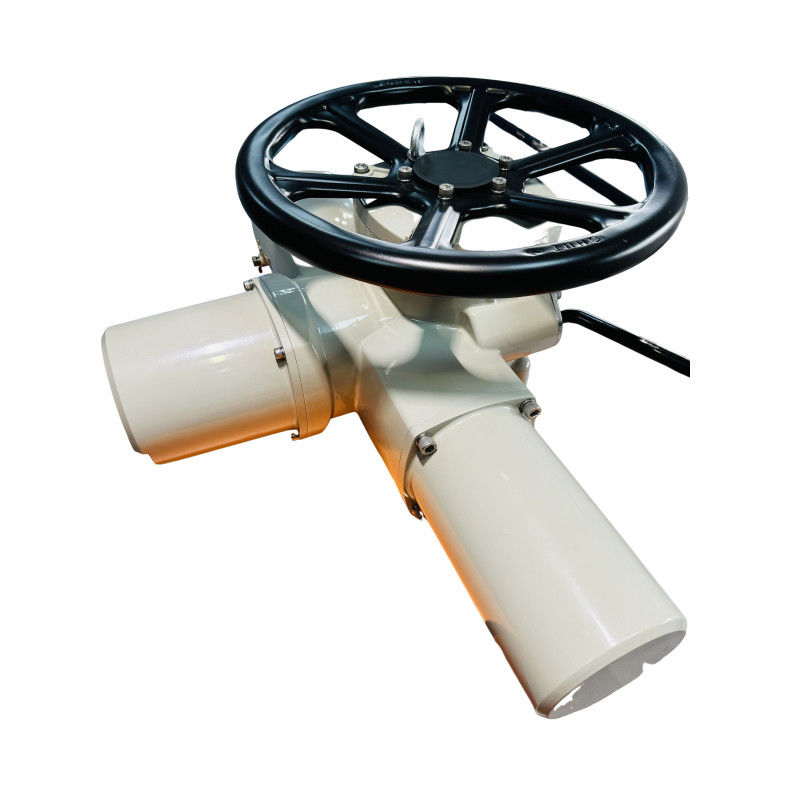
Body material options
The dual-connection intelligent actuator is offered with a body material of Aluminium Alloy, Stainless Steel or Carbon Steel. These options decide how the actuator survives its environment; they do not change which connection type is correct. What they do change is the mounting assembly, because the flange and stem adapter that carry the load must be compatible with the actuator housing material over the life of the installation.
- Aluminium Alloy — used where weight reduction matters, for example on the DQ series and on ZXC-series rotary actuators.
- Stainless Steel — selected for corrosive and wet environments; the ZXC type electric rotary actuator lists Aluminium Alloy and Stainless Steel as its material options.
- Carbon Steel — available where a higher-strength, cost-balanced mounting structure is required.
Protection grade
Chenglei actuators are available at IP65, IP67 and IP68, with the DQ series additionally offered in NEMA 4/4X/7&9 enclosures. The ZXC type electric rotary actuator is rated IP67 and NEMA 4X, and the CLZXC4000 is rated IP65/67. Environmental limits are typically -20°C to +60°C, with special orders covering -60°C to +70°C, at relative humidity up to 95% at +25°C.
Water and gas do not enter an actuator through the enclosure panels. They enter through entries: the cable gland, the cover joint and the actuator-to-valve interface. This is why the interface must be specified together with the protection grade rather than after it. On a Middle East oil field project, the protection strategy combined a C5-M grade anti-corrosion coating with double-sealed wiring technology to isolate corrosive gases and moisture, because the site combined high salt spray, hydrogen sulphide and high temperature.
Step-by-Step Breakdown: A Connection Selection Checklist
Work through the following sequence before releasing an enquiry. Each step narrows the interface, and the steps are ordered so that a mismatch is found before a purchase order rather than after delivery.
- Identify the valve motion type. Establish whether the valve is quarter-turn (part turn) or multi-turn/linear. This determines whether rotational load is the only load in play.
- Determine the governing load. Confirm with the valve manufacturer whether the actuator sees torque only, or torque plus axial thrust. This single answer selects JB2920 torque type or ISO5210 (GB/T 12222) thrust flange type.
- Collect the interface geometry. Record the flange pattern, the stem diameter and the stem engagement. Chenglei flange sizes run from F05/F07 on QI10 and QI15, through F10/F12 on QI60, to F14/F16 on QI500 and Z45, with maximum stem diameters from 19 mm to 55 mm depending on model.
- Match nominal torque to the valve requirement. Compare the actuator's nominal torque with the value stated by the valve supplier. The QI500 delivers 5,000 N·m; the ZXC type electric rotary actuator covers a torque range of 10 N·m to 4,000 N·m.
- Confirm the control method and duty. Specify On-Off or Modulating, then confirm the motor duty rating (S2 10/15/30 min, or S1/S3/S4/S6 at 24%/40%) against the actual number of cycles the process requires.
- Confirm the environment. Select body material (Aluminium Alloy, Stainless Steel or Carbon Steel) and protection grade (IP65/IP67/IP68) against the site's corrosion class, washdown practice and humidity.
- Confirm hazardous-area classification if applicable. For explosive atmospheres, verify the ATEX / Exd BT4 / CT4 rating against the zone, gas group and temperature class required for the site, referencing the IEC 60079-0 and IEC 60079-1 framework.
- Confirm manual override and feedback. Check the manual override arrangement (handwheel is standard on the dual-connection intelligent model) and the position feedback signal (4-20 mA or 0-10 VDC) if modulating control is specified.
- Validate on a sample and freeze the drawing. Physically check the flange pattern and stem engagement on the actual valve before volume manufacturing, then record the confirmed interface on the final drawing.
Use Cases: Which Connection Fits Which Application
Oil & Gas — quarter-turn isolation and pipeline control
Torque-type connections dominate quarter-turn isolation and pipeline duty, where the actuator rotates a ball, butterfly or plug element through a defined travel angle. Travel angles of 90°, 120° and 180° are available on the ZXC type electric rotary actuator, and explosion-proof variants with ATEX / Exd BT4 / CT4 ratings cover hazardous areas.
Field evidence from a Middle East petroleum engineering project shows how the surrounding specification is built. A 200-set order for a large-scale oil valve project has run for six years in a desert environment with high corrosion from salt spray and hydrogen sulphide and high ambient temperature. The project was secured on the basis of high-precision control and high reliability, with stable oil field production and reduced downtime caused by leaks. The technical highlights were a C5-M grade anti-corrosion coating that exceeds conventional standards, and double-sealed wiring technology that isolates corrosive gases and moisture.
Oil & Gas and energy infrastructure — remote automated control
A Russian strategic partner in oil, natural gas and energy infrastructure required remote automated control of local pipelines with resistance to extremely cold climate, large temperature differences and potentially explosive gas environments. The first batch of over 400 high-end intelligent electric actuators passed the factory acceptance test conducted by the Russian delegation, and the product holds EX explosion-proof certification. It was verified to start stably and perform precise control at minus 40 degrees Celsius, addressing low-temperature failure modes such as LCD failure, lubricant solidification and material brittleness.
Process, Industrial and Power — continuous production lines
A large non-ferrous metal group in the United States applied actuators to raw material grinding, high-temperature digestion, sedimentation separation and evaporation stations — an environment with strong vibration, high temperature and dust. The successful deployment of nearly a thousand intelligent actuators ensured uninterrupted 24/7 operation of the production line, and the project achieved Profinet industrial Ethernet communication interconnection across the entire factory area, supporting the site's position as a benchmark intelligence project. The design response was to separate the mechanical body from the control unit so the precision control part stays away from the vibration source.
Comparison Table: JB2920 Torque Type vs ISO5210 Thrust Flange Type
The attribute rows below reflect the published specification of Chenglei's dual-connection intelligent electric valve actuator, which is offered with either connection type on the same electrical platform. The load-direction rows describe the engineering purpose of each interface and should be confirmed against the specific valve data.
| Selection dimension | JB2920 torque type | ISO5210 (GB/T 12222) thrust flange type |
|---|---|---|
| Primary load transferred | Rotational torque, reacted at the mounting flange | Axial thrust together with rotational torque |
| Typical actuator family at Chenglei | Part-turn models such as QI10, QI15, QI60, QI500 | Multi-turn and linear models such as Z5, Z10, Z30, Z45 and the ZXC series |
| Example flange patterns | F05/F07 (QI10, QI15), F10/F12 (QI60), F14/F16 (QI500) | F10 (Z5, Z10), F14 (Z30), F16 (Z45); ZXC linear uses flange connection |
| Example max stem diameter | 19 mm (QI10/QI15), 38 mm (QI60), 55 mm (QI500) | 28 mm (Z5/Z10), 40 mm (Z30), 48 mm (Z45) |
| Control method available | On-Off or Modulating | On-Off or Modulating |
| Motor duty options | S2 10 min / 15 min / 30 min, or S1/S3/S4/S6 at 24% / 40% | S2 10 min / 15 min / 30 min, or S1/S3/S4/S6 at 24% / 40%; CLZXC4000 rated 10 minutes short time |
| Body material options | Aluminium Alloy / Stainless Steel / Carbon Steel | Aluminium Alloy / Stainless Steel / Carbon Steel; DQ series uses Aluminium Alloy |
| Protection grade | IP65 / IP67 / IP68 | IP65 / IP67 / IP68; ZXC linear rated IP65, ZXC rotary IP67 and NEMA 4X |
| Explosion-proof option | ATEX / Exd BT4 / CT4 | ATEX / Exd BT4 / CT4; DQ series NEMA 4/4X/7&9 |
| Manual override | Yes, with handwheel | Yes, with handwheel; ZXC rotary offers handwheel or lever |
| Position feedback | 4-20 mA or 0-10 VDC (ZXC series) | 4-20 mA or 0-10 VDC (ZXC series); 4-20 mA signal input on DQ series |
Compliance, Testing and Supply Verification
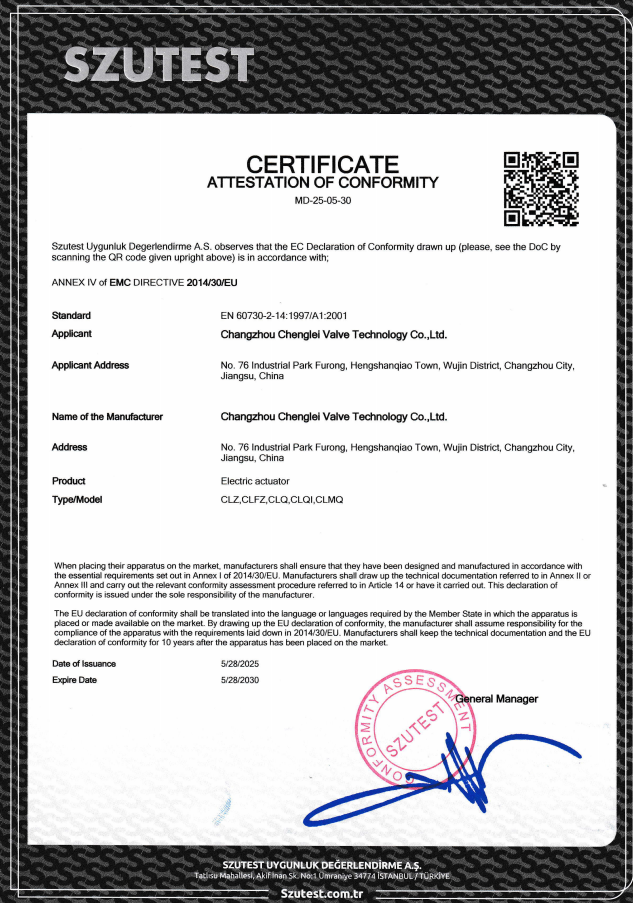
Chenglei holds CE certification under standard EN 60730-2-14:1997/A1:2001, issued by szutest on 28 May 2025 and valid to 28 May 2030, covering the EU market. Explosion-proof variants carry ATEX / Exd BT4 / CT4 ratings, and the ZXC type electric rotary actuator lists CE, ATEX and SIL3 certifications with a two-year warranty.
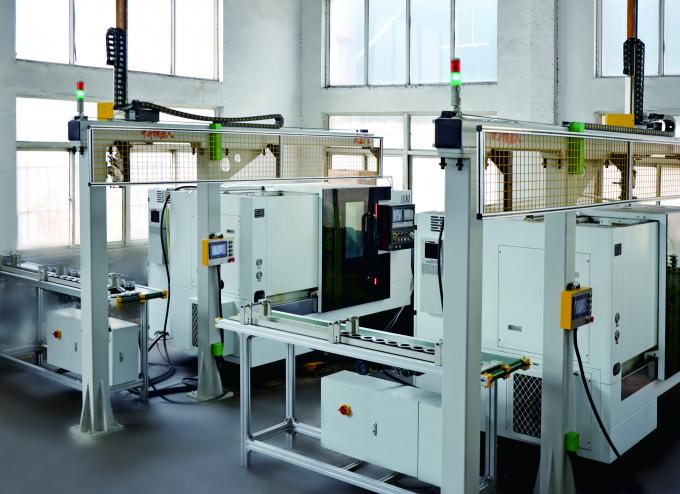
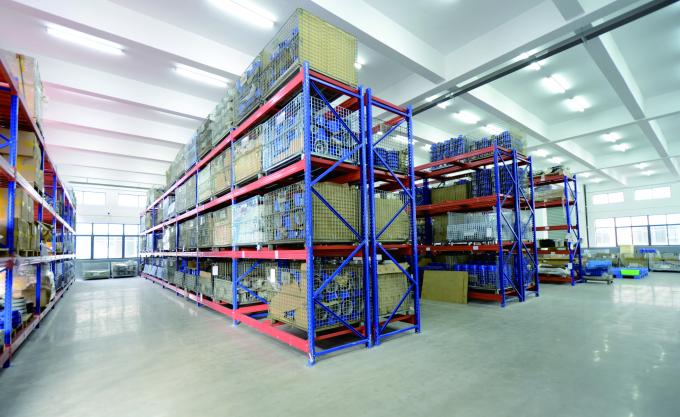
Manufacturing and supply facts relevant to a connection decision include a 20,000 m² factory, 50 or more CNC machining centres and CNC lathes, a 25-engineer R&D team, 100% testing of every unit, and a stated supply ability of 3,000 sets per month. Declared lead time is 10–15 working days for orders of 1–100 units, with larger volumes negotiated. OEM and ODM production is available with voltage and logo customisation.
FAQ: Electric Actuator Connection Selection
Does the connection type affect explosion-proof compliance?
No. Explosion protection is determined by the enclosure and its certification, not by the mechanical interface. Chenglei explosion-proof actuators are offered with ATEX / Exd BT4 / CT4 ratings, which sit within the IEC 60079-0 and IEC 60079-1 framework for flameproof enclosures, and gas group and temperature class requirements such as IIA, IIB and IIC and T1–T6 must be matched to the site. The connection still matters mechanically, because a poorly fitted interface can stress an enclosure and its cable entries and compromise the sealing that the certification assumes.
Can the same actuator model be supplied with either a JB2920 torque-type or an ISO5210 thrust-flange connection?
Yes. Chenglei specifies its intelligent electric valve actuator with “Connection Type: JB2920 Torque Type or ISO5210 (GB/T 12222) Thrust Flange Type.” Both variants share one electrical platform: 380V/110V/220V/440V/660V AC or 12V/24V DC supply, 50 Hz/60 Hz rated frequency, On-Off or Modulating control, IP65/IP67/IP68 protection, F-class insulation, thermal protection, battery backup, Bluetooth connection and handwheel manual override. The choice between the two is therefore a mechanical decision driven by valve load, not an electrical or control decision.
What are the minimum order quantity, production capacity and lead time?
The stated minimum order quantity is 1 set, which allows a single unit to be ordered for validation before any volume commitment. Declared supply ability is 3,000 sets per month, supported by a 20,000 m² factory with more than 50 CNC machining centres and lathes and an annual output of 120,000 units. Lead time is 10–15 working days for orders between 1 and 100 units, with larger quantities negotiated individually. OEM and ODM production with voltage and logo customisation is available.
Can the connection be validated on a sample before a production order?
Yes, and this is the recommended route for any first-time interface. Because the minimum order quantity is 1 set and every unit is 100% tested before shipment, a buyer can mount a single actuator on the actual valve and check flange pattern, stem engagement, travel angle and torque behaviour under real conditions. Validating on a sample converts an assumed interface into a measured one, and the confirmed dimensions can then be frozen on the drawing used for the volume order.
What happens after delivery if the actuator needs support?
Chenglei provides remote after-sales support, and the ZXC type electric rotary actuator carries a two-year warranty. For connection-related questions, the practical starting point is the frozen interface drawing from the sample validation stage, since it records the exact flange pattern, stem diameter and mounting arrangement that were confirmed. Sharing that drawing plus the current protection grade and control configuration allows support to be targeted at the right subsystem rather than the whole assembly.
Conclusion: Fix the Load, Then Fix the Interface
Between the two options, the selection logic is consistent: a JB2920 torque-type connection suits actuators whose only job is to transmit and react rotational torque, and an ISO5210 (GB/T 12222) thrust-flange connection suits actuators that must also absorb axial thrust. Everything else — On-Off versus modulating control, Aluminium Alloy, Stainless Steel or Carbon Steel bodies, and IP65, IP67 or IP68 protection — is specified around that decision rather than instead of it.
The verification sequence is short and repeatable: establish the load direction, read the flange pattern and stem diameter from the valve data, match nominal torque to the valve requirement, confirm duty cycle, environment and hazardous-area classification, then prove the interface on a sample before volume manufacturing. Applied in that order, the connection stops being the last uncertain line on the datasheet and becomes the first confirmed one.
Next Step
If you are evaluating a connection for a specific valve, send the valve motion type, required torque or thrust, flange pattern and stem diameter to the Chenglei engineering team. A single-set sample can be supplied for physical validation before any volume order, with declared lead time of 10–15 working days for 1–100 units.
Email: terry.gui@cz-chenglei.com | WhatsApp: +8613401325958 | Website: www.electricvalvesactuators.com
Download the full product catalogue: Chenglei Electric Actuator Catalogue (PDF)
About Chenglei
Changzhou Chenglei Valve Technology Co., Ltd. is a manufacturer of valve electric actuators based in Changzhou, Jiangsu, China. Founded in 2016, the company operates a 20,000 m² facility with 100 employees, a 25-engineer R&D team, an annual output of 120,000 units and an 80% export ratio serving global markets. Its CL series valve electric actuators are applied in Oil & Gas, Water & Power, and Chemical, Process & Industrial sectors.
Have Questions or Need More Details?
Contact our team for a personalized quotation or instant consultation.
Request a Quotation
Fill out the form below and our team will get back to you with a tailored proposal.
WhatsApp Direct Chat
Prefer to chat in real-time? Message us on WhatsApp for instant assistance & quick answers.
- Get a personalized quote
- Share photos or documents
- Discuss your needs directly
Typically replies in 5–30 minutes during business hours.