How to Evaluate an Electric Actuator Supplier's Capacity and Delivery Assurance
A delivery date is only as reliable as the capacity evidence behind it. Before a procurement team commits to a valve actuation schedule, it should be able to document five things in writing: the committed monthly output for the exact configuration being ordered, the physical address where the unit is manufactured, the body materials the supplier can actually machine, the voltage and control modes it can build, and the packaging and test records that travel with each shipment.
An Electric Actuator rarely sits in a flexible part of a project schedule. It sits on the critical path of a plant shutdown, a pipeline upgrade, or a new process line, and when it arrives late the cost is measured in delayed commissioning rather than in freight. That is why supplier evaluation in 2026 is shifting away from brand familiarity and toward verifiable capability: what the factory can produce, at what rate, and with what documentation.
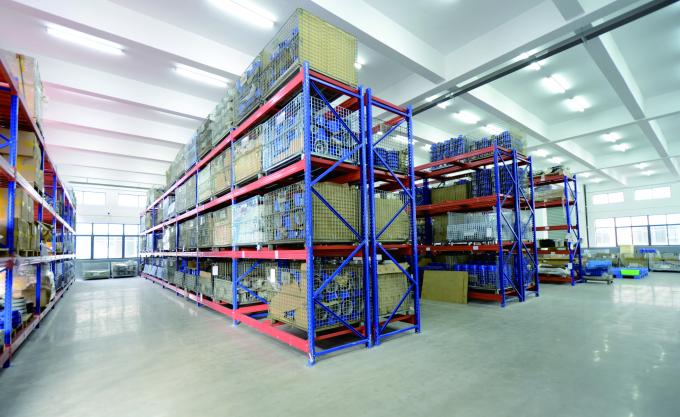
Chenglei — Changzhou Chenglei Valve Technology Co., Ltd. — is a manufacturer of valve electric actuators based in Changzhou, Jiangsu, China, serving global industrial markets from a 20,000 m² facility. Its product focus is the Electric Actuator range built around the CL series, including the Intelligent Adjustment Electric Valve Actuator category, and its stated capacity commitment is 3,000 sets per month. This guide uses that framework to show what a buyer should verify, and which questions separate a manufacturer from a reseller.
Problem Definition: The Three Meanings of Supplier "Capacity"
Suppliers answer capacity questions with one number, but buyers need three. Capacity in the actuator industry means different things depending on who is speaking, and only the third meaning protects a project schedule.
- Nameplate capacity — the volume a factory could theoretically reach at full load. It is the figure most often quoted and the least useful for planning.
- Demonstrated capacity — the volume actually produced in a recent period for a comparable configuration. This is verifiable through production records, work-in-progress, or a plant visit.
- Committed capacity — the volume a supplier will reserve for your configuration inside a specific delivery window, ideally written into the purchase order.
The second failure point is configuration granularity. A factory with strong throughput on Intelligent On Off Electric Valve Actuators may have far less throughput on Intelligent Modulating Electric Valve Actuators, because the two builds consume different control modules, position feedback hardware, and calibration time. A monthly figure quoted for actuators in general tells a buyer nothing about the shipments they will actually receive.
The third failure point is origin opacity. A meaningful share of quotations in this category circulate through trading intermediaries that do not control a machining line, a test bench, or a packaging station. When a delivery date slips, an intermediary can only relay an excuse. A manufacturer can reschedule machines.
Decision rule: ask for capacity in units of "the configuration I am ordering, per month, at the address where it is made." An answer that omits any of the three elements should be treated as a marketing figure rather than a planning figure.
Industry Background: Growth, Standards, and Why Brand Share Is Not Delivery Assurance
Demand for electric actuation continues to expand, which increases the number of suppliers quoting for the same project. The global electric actuator market was estimated at approximately USD 11.5 billion in 2024, with a projected CAGR of 6.5% to 7.2% through 2034, according to Zion Market Research. Published estimates vary with scope — a narrower standalone-actuator estimate places 2025 at USD 4.85 billion — so buyers comparing market reports should confirm whether a figure includes integrated valve-actuator assemblies.
Asia Pacific dominated the electric valve actuator market with a 38.5% revenue share in 2025, valued at over USD 1.8 billion, driven by industrialization in China and India (Dataintelo). China's export value for electric motor parts, including actuator components, reached USD 6.43 billion in 2024, representing 26.1% of global exports (Observatory of Economic Complexity). A deep and competitive supply base is good for pricing, but it also means the distance between the strongest and weakest supplier on capacity discipline is wide.
Regulatory structure is comparatively stable. Explosion-proof electric actuators are standardized under IEC 60079-0 (General Requirements) and IEC 60079-1 (Flameproof Enclosures 'd') for hazardous environments, and units are classified into gas groups (IIA, IIB, IIC) and temperature classes (T1–T6), with Group IIC required for hydrogen environments. A buyer comparing an Explosion Proof Actuator BT4 against an Explosion Proof Actuator CT4 is comparing a IIB gas-group rating against a IIC rating at the same T4 temperature class — a difference that must be matched to the actual zone rather than to the price list.
Scale, meanwhile, is not the same as speed. Rotork plc held a 14% global market share in the linear electric actuator segment as of 2024 (Market Reports World), and Emerson Electric Co. is estimated at 12–15% of the global electric actuator market with USD 17–18 billion in relevant group revenue (Spherical Insights). Large suppliers bring deep engineering benches and long allocation queues; smaller manufacturers can often commit faster on a specific build. Both statements are neutral facts about market structure, and neither tells a buyer whether their particular order will ship on time.
A further consideration is the interface trend. Intelligent electric actuators are moving toward Industrial Ethernet protocols (Profinet, EtherNet/IP) and 5G edge connectivity for digital twin integration. Whether a supplier can answer protocol questions at quotation stage is usually a reliable indicator of how it will behave during factory acceptance testing and commissioning.
Detailed Solution: Five Verification Layers for Capacity and Delivery Assurance
Layer 1 — Production Capacity That Matches the Ordered Configuration
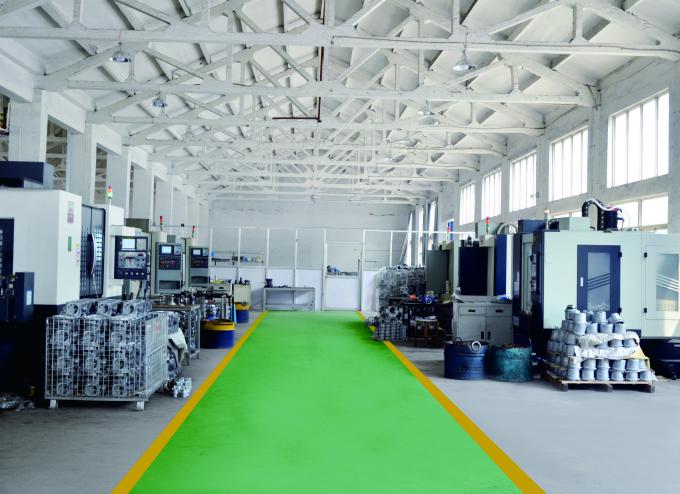
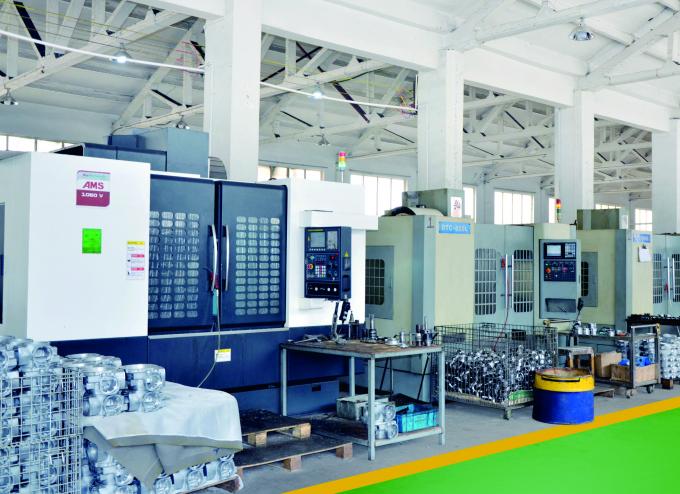
Chenglei states a monthly capacity of 3,000 sets and an annual output of 120,000 units, produced by around 100 employees on a 20,000 m² site using more than 50 CNC machining centres, CNC lathes, and various inspection equipment. Those figures only become useful when they are decomposed. A buyer should ask how many machining centres are dedicated to actuator bodies, what the monthly figure is for the ordered body material and control mode, and what share of the 3,000-set capacity is already committed to other customers in the target month.
Output per unit of floor space matters as much as the headline number, because it reveals whether a supplier machines parts in-house or assembles imported bodies — a distinction that directly affects recovery time when a delivery slips.
Layer 2 — Manufacturing Origin and Engineering Ownership
Origin should be a specific address rather than a country name. Chenglei manufactures at Building A5, Intelligent Equipment Industrial Park, Hengshanqiao Town, Economic Development Zone, Changzhou City, China, and operates an engineering team of 25 engineers. Two process controls are worth asking about specifically, because they surface later as delivery reliability:
- A selection database that requires mandatory input of medium characteristics, maximum differential pressure, and pipe diameter, and automatically matches actuators with a safety factor of 1.5 times or more.
- A technical review system in which large projects or non-standard conditions — high temperature, explosion-proof areas — must be countersigned and confirmed by the sales, technical, and production departments.
Both controls reduce the probability of late-stage rework that destroys a delivery schedule. A supplier without them tends to discover mismatches during final testing, which is the most expensive place to discover anything.
Layer 3 — Body Material and Environmental Fit
Buyers should confirm which body materials the supplier can actually machine and stock: Aluminum Alloy, Stainless Steel, and Carbon Steel. The choice is environmental rather than cosmetic. Stainless steel with appropriate surface protection is relevant in highly corrosive oil fields in the Middle East; aluminum alloy is common where weight and thermal behaviour matter; carbon steel serves applications where mechanical strength and cost balance differently.
Protection figures should be requested in writing with their test conditions attached. Chenglei specifies IP68 protection — submerged for 48 hours — and an operating temperature range of −40°C to +70°C, extendable to −60°C. The mainboard is coated with a conformal coating for moisture, salt-spray, and mould resistance, and the enclosure carries independent grounding bolts both internally and externally. For a procurement team, the practical question is which of these protections applies to the exact model quoted and which is only a general series claim.
Layer 4 — Voltage and Control Configurability
Configuration range is where delivery schedules are most often lost. A supplier that builds one standard voltage can commit quickly; a supplier that claims every variant will usually need to re-plan when the order arrives. Chenglei's Intelligent Adjustment Electric Valve Actuator range is configurable across 380V, 110V, 220V, 440V, and 660V AC, or 12V and 24V DC, with On-Off or Modulating control. Where a plant integrates with a control system, bus communication is available through Profinet, Modbus, or Profibus.
Three configuration details deserve a written answer before the purchase order is issued:
- Adjustable dead zone — adjustable from 0.5% to 5%, which determines how tightly a modulating unit tracks a setpoint.
- Setting method — non-invasive setting through an infrared remote control or a rotary knob, so the electrical cover is not opened in the field and moisture and dust are not introduced.
- Voltage level labels and wiring schematics in the junction box, an error-proofing measure against incorrect on-site power connections.
Configurable and available within your lead time are different claims. The right question combines both: which voltage and control combinations can be built, tested, and documented inside the delivery window being offered?
Layer 5 — Packaging, Testing, and Documentation
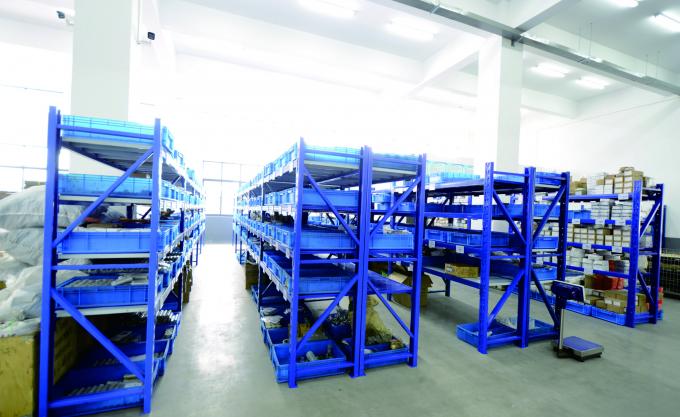
Packaging is part of delivery assurance, not an afterthought. Chenglei ships in carton or wooden box, and the specification should be named in the purchase order — the wooden-box option exists because sea freight, transshipment, and open storage are normal conditions for industrial imports. Buyers should also ask how the unit is braced inside the packaging and whether accessories such as the infrared remote control are secured in a dedicated compartment.
Testing documentation converts a claim into evidence. Several control functions are directly relevant: phase sequence detection and automatic correction on three-phase asynchronous motors, so a reversed live-wire connection on site either self-corrects or triggers a refusal to start with an error report; valve position memory with a self-learning function for full-open and full-close limits, which prevents over-torque caused by inaccurate manual settings; and optocoupler isolation on input and output interfaces.
Step-by-Step Breakdown: An Eight-Step Capacity Audit Before You Commit
- Request committed monthly output for your configuration. Combine the configuration, the monthly volume, and the delivery window in one question. For planning purposes, Chenglei's stated figure is 3,000 sets per month against an annual output of 120,000 units.
- Verify the manufacturing address. Confirm the exact production site — Chenglei's is in Changzhou, Jiangsu, China — and ask whether any process, including body machining or final testing, is subcontracted.
- Confirm material availability. Ask which of Aluminum Alloy, Stainless Steel, or Carbon Steel is machined in-house, what the lead time difference between them is, and which protection level applies to each.
- Map the voltage and control build. Confirm AC options (380V/110V/220V/440V/660V) or DC options (12V/24V), and whether the unit is On-Off or Modulating. Ask how many units of that exact combination were built in the previous quarter.
- Ask about integration and diagnostics. Which bus protocols are supported (Profinet, Modbus, Profibus), what the adjustable dead zone range is (0.5% to 5%), and how fault codes are read without opening the enclosure.
- Confirm protection and environment ratings. IP68 with its test condition (submerged for 48 hours), temperature range (−40°C to +70°C, extendable to −60°C), and whether a split-type control unit is available for vibration, high-temperature, or high-altitude locations.
- Lock the packaging specification. Carton or wooden box, stated in the purchase order, with the bracing method and accessory placement described.
- Require the test and document set with shipment. Phase-sequence verification, limit self-learning records, and the configuration parameters needed for commissioning. Confirm whether parameters can be copied from unit to unit in one action, which shortens site work on multi-unit orders.
Steps 1 through 3 establish whether the supplier can build the order. Steps 4 through 8 establish whether it will arrive ready to install. Delivery assurance failures are more often found in the second group than the first, because buyers audit capability and forget to audit readiness.
Use Cases: Where Delivery Assurance Decides the Outcome
High-end industrial projects in Russia
Chenglei's project record includes a breakthrough for China's intelligent manufacturing in the high-end Russian market, successfully replacing some traditional European and American brands. Projects of this type test configuration discipline as much as capacity: the actuator must arrive with parameters matched to the plant's control system and with documentation that satisfies the project's acceptance process.
Extreme cold and high-temperature process areas
Where ambient conditions reach −40°C, and in some cases require extension to −60°C, the protection and temperature specification becomes the primary selection criterion. The same logic applies to high-temperature digestion and other thermally demanding process sections, where a split-type control unit can be separated from the actuator body to limit heat and vibration exposure.
Corrosive oil fields and hazardous zones
In highly corrosive oil field environments, the combination of a stainless steel body, IP68 protection, and conformal coating is what keeps a unit serviceable across a maintenance cycle. In hazardous zones, the explosion-proof classification — gas group and temperature class — must match the area classification, and the certificate must be traceable to the exact model.
Emergency shut-off on oil and gas pipelines
Emergency shut-off duty requires continuous torque monitoring and anti-seizure protection, together with position feedback from an absolute encoder. For procurement, the delivery question is whether the supplier can test and document these functions before shipment rather than during site commissioning.
Intelligent plants integrating with DCS/PLC
Where the actuator must sit inside a plant's control architecture, bus communication and remote diagnostics become part of the delivery specification. Standby power consumption below 5W in bus mode, with output torque on demand and energy consumption reduced by 15–30% compared with traditional methods, are the figures a project engineer will ask for during integration planning.
Comparison Table: Intelligent Configuration vs Conventional Baseline
The table compares the intelligent configuration with the conventional baseline it is normally measured against, using supplier data only. Cells marked "not stated" indicate that the data used for this guide does not quantify the conventional side.
| Dimension | Intelligent electric valve actuator (supplier data) | Conventional baseline |
|---|---|---|
| Initial procurement cost | Approximately 1.5 to 2.5 times a traditional model, depending on functionality | Baseline (1.0x) |
| Installation cost | Bus communication removes significant cable, cable tray, and IO card content; total installation cost reduced by 20–40% | Hard-wired installation baseline |
| Energy consumption | 15–30% lower than traditional methods; standby consumption below 5W in bus mode; output torque on demand | Baseline |
| Maintenance | Low frequency; non-invasive setting; self-diagnostic reminders; fault codes read through the bus or infrared remote control | Not stated |
| Spare parts | High interchangeability of control modules; one-click copying of software parameters | Not stated |
| Service life | At least 30,000 operations without maintenance, depending on operating conditions; MTBF above 50,000 hours | Not stated |
| Protection and temperature | IP68 (submerged for 48 hours); −40°C to +70°C, extendable to −60°C | Not stated |
| Best-fit applications | Harsh environments, critical process sections, and intelligent plants requiring remote monitoring and DCS/PLC integration | Not stated |
Claim-to-Evidence Table: What to Ask For, and Why It Matters
| Supplier claim | Evidence to request | Why it decides the schedule |
|---|---|---|
| Monthly production capacity | Committed monthly volume for the exact configuration, plus annual output and machine count | Prevents a nameplate figure from being treated as a delivery plan |
| Manufacturing origin | Full production address and confirmation of which processes are in-house | Determines how quickly a slip can be recovered |
| Body material options | Material list (Aluminum Alloy, Stainless Steel, Carbon Steel) with lead time by material | Material availability, not assembly capacity, is often the real constraint |
| Voltage and control range | Written configuration list (380V/110V/220V/440V/660V AC or 12V/24V DC; On-Off or Modulating) | A configuration change late in the order resets the schedule |
| Environmental protection | Rating with test conditions (IP68, 48-hour submersion; −40°C to +70°C) | Prevents site rejections after delivery |
| Compliance classification | Certificate traceable to the exact model; gas group and temperature class matched to the zone | A mismatched classification blocks installation entirely |
| Packaging | Carton or wooden box specification written into the purchase order | Transit damage is a silent schedule loss |
Frequently Asked Questions
What certifications should an explosion-proof electric actuator supplier be able to document?
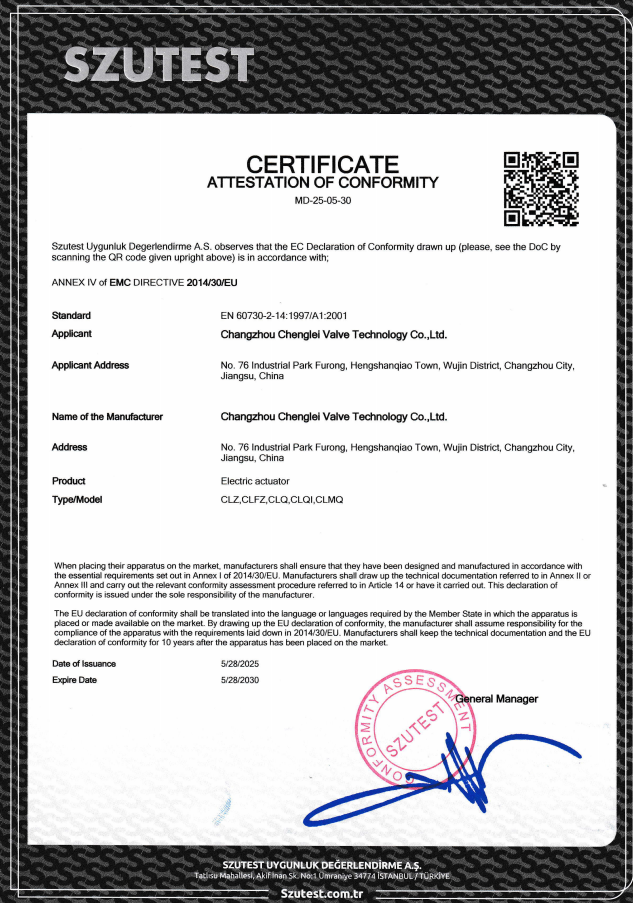
Explosion-proof electric actuators are standardized under IEC 60079-0 (General Requirements) and IEC 60079-1 (Flameproof Enclosures 'd') for hazardous environments. Units are classified into gas groups (IIA, IIB, IIC) and temperature classes (T1–T6), and Group IIC is required for hydrogen environments; in designations such as BT4 and CT4, the letter indicates the gas group and the number indicates the temperature class. Chenglei's internal control policy requires that actuators used in explosion-proof areas possess national explosion-proof certificates (such as Ex d / Ex e) and 3C certification, and that input and output interfaces use optocoupler isolation with conformal coating on the mainboard. For procurement purposes, the certificate must be traceable to the exact model being quoted — a series-level document is not a substitute.
How can I verify an electric actuator supplier's monthly production capacity?
Convert the claim into three figures: nameplate, demonstrated, and committed. Chenglei states 3,000 sets per month and an annual output of 120,000 units, produced by around 100 employees on a 20,000 m² site with more than 50 CNC machining centres, CNC lathes, and inspection equipment, supported by 25 engineers. A buyer should then ask how much of that capacity applies to their specific body material, voltage, and control mode, and how much is already committed in the target month. Capacity is a planning fact, not a general claim, and it is only meaningful when tied to a configuration and a date.
Is an intelligent electric actuator worth the higher purchase price?
The initial procurement cost of an intelligent actuator is approximately 1.5 to 2.5 times that of a traditional model, depending on functionality, but the cost structure shifts after installation. Bus communication can remove significant cable, cable tray, and IO card content, reducing total installation cost by 20–40%. Energy consumption is reduced by 15–30% compared with traditional methods, with standby consumption below 5W in bus mode. Maintenance frequency is low, fault codes are read through the bus or an infrared remote control, and control modules have strong interchangeability with one-click copying of software parameters. The decision therefore depends on duty cycle, environment, and how much downtime costs at the specific installation.
Can I validate a unit before committing to a full production order?
The relevant question is not whether a sample is possible, but whether the sample is built on the same platform, voltage, control mode, and parameter set as the production order. For the Intelligent Adjustment Electric Valve Actuator range, three features support validation: non-invasive setting through an infrared remote control or rotary knob, so configuration can be checked without opening the electrical cover; self-learning of full-open and full-close limits, which confirms the travel range before shipment; and one-click copying of software parameters, which makes multiple units behave identically. Non-standard or high-temperature and explosion-proof conditions are additionally reviewed and countersigned by the sales, technical, and production departments before release.
What should a delivery assurance clause contain before I commit to a schedule?
A delivery assurance clause should state the committed monthly capacity for the exact configuration, the material lead time for the selected body material (Aluminum Alloy, Stainless Steel, or Carbon Steel), the voltage and control combination (380V/110V/220V/440V/660V AC or 12V/24V DC; On-Off or Modulating), the bus protocol if applicable (Profinet, Modbus, or Profibus), the packaging specification (carton or wooden box), and the test records that ship with the goods, including phase-sequence verification and limit self-learning data. It should also name a review cadence, so that a slip becomes a scheduled conversation rather than a surprise. Buyers who want to check these items against a live quotation can contact Chenglei directly at terry.gui@cz-chenglei.com or by WhatsApp on +8613401325958, and the full product catalogue is available for download below.
Conclusion: Capacity Is a Document, Not a Promise
Evaluating an Electric Actuator supplier's capacity and delivery assurance comes down to converting statements into documents. A manufacturer that can name its monthly output for your configuration, its production address, its in-house material range, its voltage and control combinations, and its packaging and test records has given a procurement team something that can be planned against. A supplier that answers with adjectives has not.
Chenglei's verifiable position is straightforward: 3,000 sets per month and 120,000 units of annual output from a 20,000 m² site in Changzhou, Jiangsu, China; more than 50 CNC machining centres and a 25-engineer technical team; body options in Aluminum Alloy, Stainless Steel, and Carbon Steel; configurability across 380V/110V/220V/440V/660V AC or 12V/24V DC with On-Off or Modulating control; IP68 protection submerged for 48 hours and an operating range of −40°C to +70°C, extendable to −60°C; and export packing in carton or wooden box.

Next Step for Procurement Teams
If you are building a shortlist and need capacity, configuration, and packaging confirmed in writing, request the current quotation and specification sheet from Chenglei.
Website: electricvalvesactuators.com
Email: terry.gui@cz-chenglei.com
WhatsApp: +8613401325958
Have Questions or Need More Details?
Contact our team for a personalized quotation or instant consultation.
Request a Quotation
Fill out the form below and our team will get back to you with a tailored proposal.
WhatsApp Direct Chat
Prefer to chat in real-time? Message us on WhatsApp for instant assistance & quick answers.
- Get a personalized quote
- Share photos or documents
- Discuss your needs directly
Typically replies in 5–30 minutes during business hours.