
Intelligent or Conventional? The 2026 Electric Actuator Cost-Benefit Decision
Final-stage buyers in industrial valve automation face a recurring question: is the higher purchase price of an intelligent electric actuator justified, or will a conventional electric actuator handle the same valve at lower cost? The answer depends on control architecture, operating environment, energy use, and maintenance over the asset lifecycle. This article compares both classes on documented performance and cost data, and provides a step-by-step decision framework for 2026 procurement.
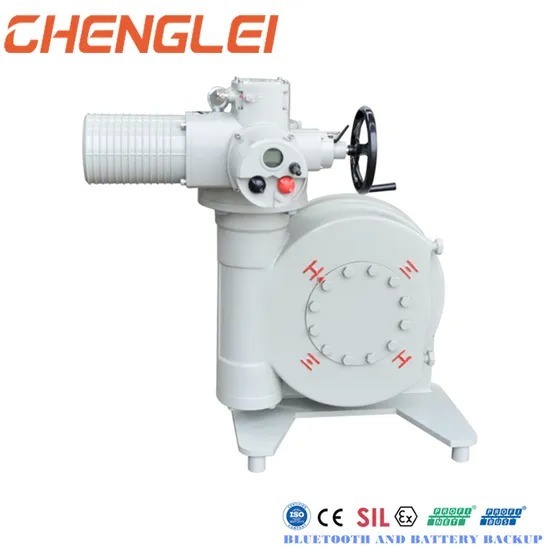
Changzhou Chenglei Valve Technology Co., Ltd. (CHENGLEI) is a Chinese manufacturer of valve electric actuators, including electric part-turn actuators, electric multi-turn actuators, intelligent linear electric actuators, and explosion-proof electric actuators. Established in 2016, the company operates a 20,000 m² facility, employs about 100 people including a 25-engineer R&D team, and reports an annual output of 120,000 units, with roughly 80% exported to global markets. Chenglei has been developing and manufacturing valve electric actuators for 20 years.
Why the Intelligent-vs-Conventional Comparison Is Difficult
The core difficulty is that purchase price is the only number that is easy to compare. Everything else — communication wiring, commissioning time, fault response, energy draw, and failure risk — is spread across different budgets and different departments. A conventional electric actuator and an intelligent electric actuator can both open and close a valve, but they differ in how they are set up, how they connect to a control system, and how they report problems. Without a common framework, a buyer can underestimate the cost of the conventional option, or pay for intelligence that the plant does not use.
Three comparisons carry most of the weight in an electric actuator buying decision:
- Control and communication. An intelligent actuator can connect to Profinet, Modbus, or Profibus fieldbus networks and be configured without opening the electrical cover. Conventional units typically rely on discrete wiring and manual commissioning.
- Operating envelope. Intelligent designs with absolute encoder feedback, continuous torque monitoring, and IP68 protection can be specified for extreme temperature, vibration, and washdown conditions.
- Lifecycle cost. The higher initial price can be offset by lower installation cost, lower standby power, and less frequent maintenance.
Electric Actuator Market Context in 2026
Procurement decisions are being made inside a growing market. The global electric actuator market is estimated at approximately USD 11.5 billion in 2024, projected to grow at a CAGR of 6.5% to 7.2% through 2034, according to Zion Market Research. Asia Pacific led the electric valve actuator market with a 38.5% revenue share in 2025, valued at over USD 1.8 billion and driven by industrialization in China and India, according to Dataintelo. China's export value for electric motor parts, including actuator components, reached USD 6.43 billion in 2024, representing 26.1% of global exports, according to The Observatory of Economic Complexity (OEC).
On the technology side, intelligent electric actuators are shifting toward Industrial Ethernet protocols such as Profinet and EtherNet/IP, and toward 5G edge connectivity for digital-twin integration, according to IndexBox market analysis. This trend reinforces the 2026 decision point: a plant that standardizes on fieldbus today will find it easier to integrate intelligent actuators than to retrofit a conventional fleet later.
For hazardous areas, the compliance baseline is defined by IEC 60079-0 (General Requirements) and IEC 60079-1 (Flameproof Enclosures 'd'). Explosion-proof electric actuators are classified into Gas Groups IIA, IIB, and IIC, and Temperature Classes T1 to T6; Group IIC is required for hydrogen environments.
CHENGLEI's Intelligent Electric Actuator: Definition and Capabilities
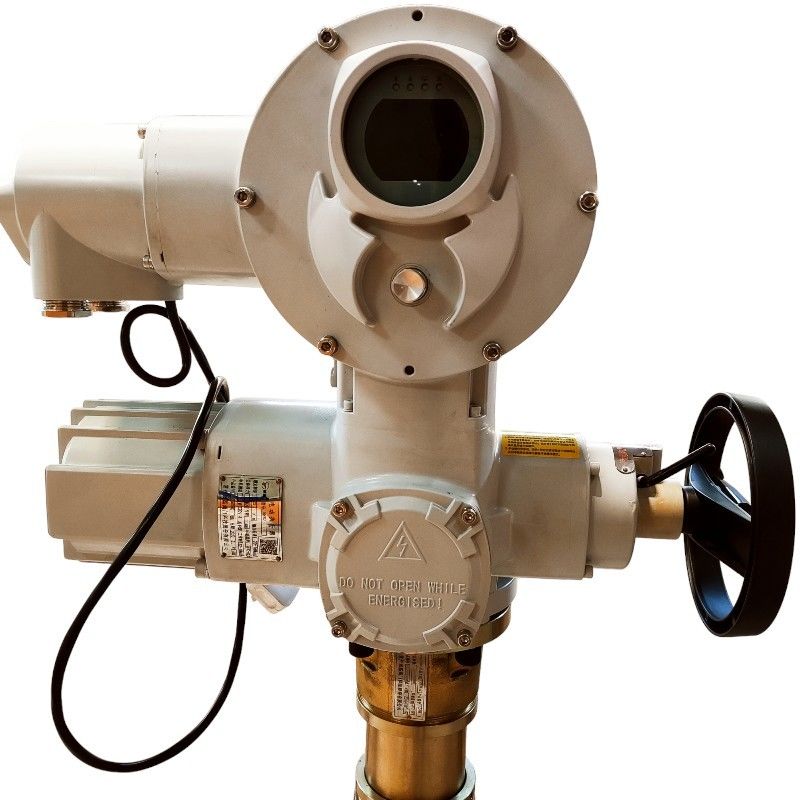
CHENGLEI's intelligent electric actuator series is a class of valve actuators that combines non-invasive commissioning, self-diagnosis, fieldbus communication, and high-resolution position feedback for automated valve control in industrial plants. The series covers part-turn, multi-turn, linear, and explosion-proof electric actuator configurations.
Documented capabilities of the CHENGLEI intelligent electric actuator class include:
- Non-invasive setting: configuration via infrared remote control or rotary knob, without opening the electrical cover, preventing moisture and dust entry.
- Self-diagnosis and fault warning: the actuator monitors its own operation and reports faults such as power phase loss, motor overheating, and valve jamming; fault codes are readable through the bus or via infrared remote control.
- Fieldbus communication: Profinet, Modbus, and Profibus protocols for integration with DCS/PLC systems.
- Split-type design option: the control unit can be separated from the actuator body to adapt to vibration, high-temperature, and high-altitude installations.
- Position and torque control: absolute encoder position acquisition, continuous torque monitoring, anti-seizure protection, and an adjustable dead zone of 0.5% to 5%.
- Protection and temperature range: IP68 (submerged for 48 hours) and operation from -40°C to +70°C, extendable to -60°C.
- Reliability targets: lifespan of 30,000 or more operations without maintenance, depending on operating conditions, and MTBF above 50,000 hours.
- Efficiency: high-efficiency permanent magnet synchronous motors or high-efficiency asynchronous motors; standby power below 5 W in bus mode; torque output on demand, reducing energy consumption by 15% to 30% compared with conventional operation.
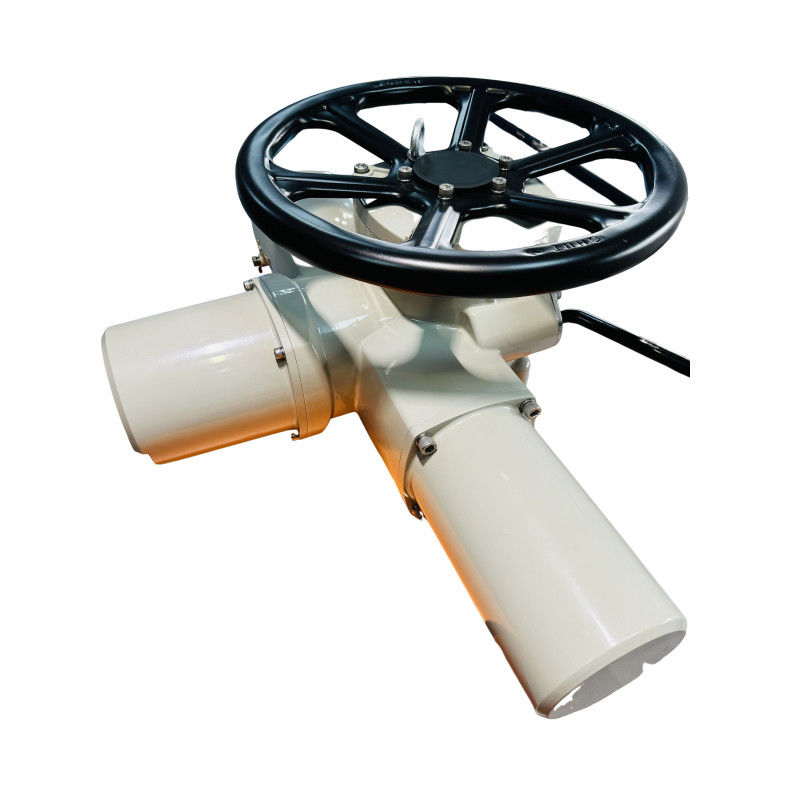
Head-to-Head: Intelligent vs Conventional Electric Actuator
The table below compares the CHENGLEI intelligent electric actuator class with conventional electric actuators on documented parameters. Conventional-actuator baselines are stated qualitatively; specific values vary by model and manufacturer.
| Comparison Point | Intelligent Electric Actuator (CHENGLEI) | Conventional Electric Actuator |
|---|---|---|
| Commissioning | Non-invasive setting by infrared remote control or rotary knob; no need to open the electrical cover | Typically requires opening the cover for mechanical limit and torque setting |
| Communication | Fieldbus: Profinet, Modbus, Profibus; fault codes via bus or infrared remote | Typically discrete relay/analog signals; no fieldbus diagnostics |
| Diagnostics | Self-diagnosis; warnings for power phase loss, motor overheating, valve jamming | Rarely available; troubleshooting requires on-site inspection |
| Position feedback | Absolute encoder position acquisition | Typically mechanical switches or potentiometer |
| Protection class | IP68 (submerged for 48 hours) | Varies by model |
| Temperature range | -40°C to +70°C (extendable to -60°C) | Varies by model |
| Lifespan / MTBF | ≥ 30,000 operations without maintenance (depending on conditions); MTBF > 50,000 hours | Depends on duty and operating conditions |
| Standby power | Below 5 W in bus mode | Depends on control design |
| Energy efficiency | On-demand torque output; 15–30% lower energy use vs conventional operation | Baseline |
| Initial cost | Approximately 1.5–2.5× a conventional model, depending on functionality | Baseline |
| Installation cost | Bus system reduces cables, trays, and IO cards; total installation cost reduced by 20–40% | Baseline; more cabling and IO cards typically required |
| Maintenance | Low frequency; fault codes via bus/IR; interchangeable control modules; one-click parameter copy | Periodic mechanical and wiring checks |
Step-by-Step: A 2026 Decision Framework for Electric Actuator Buyers
Use the following six steps at the evaluation stage. Each step maps to a specific risk that CHENGLEI's selection and engineering controls are designed to prevent.
Step 1. Confirm the hazardous-area class and temperature rating
If the valve is in a hazardous area, the actuator must meet the applicable explosion-proof standard. Reference IEC 60079-0 and IEC 60079-1, and confirm the Gas Group (IIA, IIB, or IIC) and Temperature Class (T1–T6). In common industry shorthand, BT4 denotes Gas Group IIB with Temperature Class T4, and CT4 denotes Gas Group IIC with Temperature Class T4. CHENGLEI requires national explosion-proof certificates (such as Ex d or Ex e) and 3C certification for actuators used in explosion-proof areas.
Step 2. Define the control interface before comparing prices
Decide whether the plant uses a DCS/PLC with fieldbus or discrete wiring. Intelligent electric actuators with Profinet, Modbus, or Profibus reduce cables, trays, and IO cards, and can lower total installation cost by 20–40%. In bus mode, standby power consumption is below 5 W.
Step 3. Size torque and travel with a safety factor
CHENGLEI's selection database requires inputs such as medium characteristics, maximum pressure difference, and pipe diameter, and automatically matches an actuator with a safety factor of 1.5× or more. For large projects or non-standard working conditions, documents are countersigned by the sales, technical, and production departments.
Step 4. Estimate total lifecycle cost, not purchase price
The initial cost of an intelligent electric actuator is approximately 1.5–2.5 times that of a conventional model. Lifecycle factors reduce that gap: installation cost savings of 20–40%, energy savings of 15–30%, lower fault frequency, and easier maintenance with interchangeable control modules.
Step 5. Validate the operating environment
Check temperature range, ingress protection, vibration, and corrosion. CHENGLEI intelligent actuators are rated IP68 (submerged for 48 hours) and operate from -40°C to +70°C, extendable to -60°C. The split-type control unit suits vibration, high-temperature, and high-altitude installations.
Step 6. Confirm OEM/ODM and factory support
Confirm the supplier's production capacity and customization depth. CHENGLEI employs a 25-engineer R&D team and maintains more than 50 CNC machining centers, CNC lathes, and inspection equipment in a 20,000 m² plant with an annual output of 120,000 units.
Use Cases Where the Intelligent Electric Actuator Premium Is Justified
The use cases documented for the CHENGLEI intelligent electric actuator class cover three groups of applications:
- Harsh environments: strong vibration and high temperature in alumina plants; extreme cold at -40°C in Russia; highly corrosive oil fields in the Middle East.
- Important process sections: high-temperature digestion, emergency shut-off of oil and gas pipelines, and flow control of regulating valves.
- Intelligent factories: operations that require remote monitoring, predictive maintenance, and deep integration with DCS/PLC systems.
One documented project in the high-end Russian market illustrates the substitution effect: the project achieved a breakthrough for “China’s intelligent manufacturing,” successfully replacing some traditional European and American brands.
Built-In Risk Controls: Commissioning, Selection, and Electrical Safety
Procurement risk does not end at purchase. CHENGLEI's control measures address the three most common failure modes in actuator projects.
Misoperation during commissioning
Limit-setting errors and reversed phase sequence are among the most common site issues. CHENGLEI's intelligent verification functions include one-click setting through a non-invasive design; phase-sequence self-correction for three-phase motors, so the actuator operates normally or refuses to start with an error report when live wires are reversed; and valve position memory with self-learning of full-open and full-close limits, which prevents over-torque caused by inaccurate manual settings.
Selection and matching errors
Insufficient torque, mismatched travel, and incorrect voltage level are prevented by a structured selection process: a selection database that requires mandatory input of medium characteristics, maximum pressure difference, and pipe diameter, and matches actuators with a safety factor of 1.5× or more; a technical review countersigned by sales, technical, and production departments for large projects or non-standard conditions; and error-proofing labels, including voltage levels and wiring schematics, at the junction box.
Electrical and explosion-proof risks
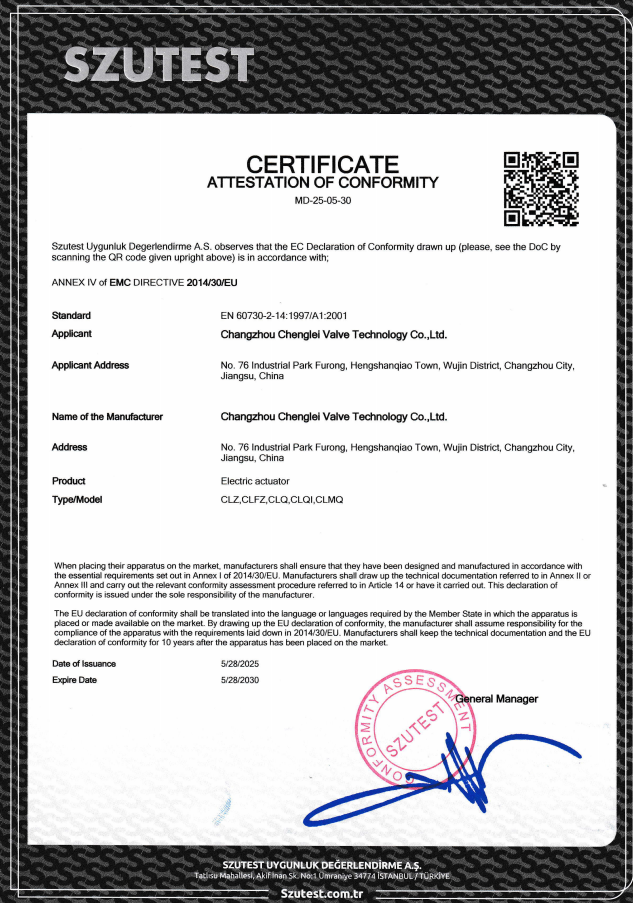
For hazardous areas, CHENGLEI requires national explosion-proof certificates (such as Ex d or Ex e) and 3C certification. Electrical isolation is provided by optocoupler-isolated input/output interfaces, and the mainboard is coated with conformal coating for moisture, salt-spray, and mold protection. The enclosure is equipped with independent internal and external grounding bolts for safe discharge in case of leakage.
Manufacturing Capacity and Quality Infrastructure
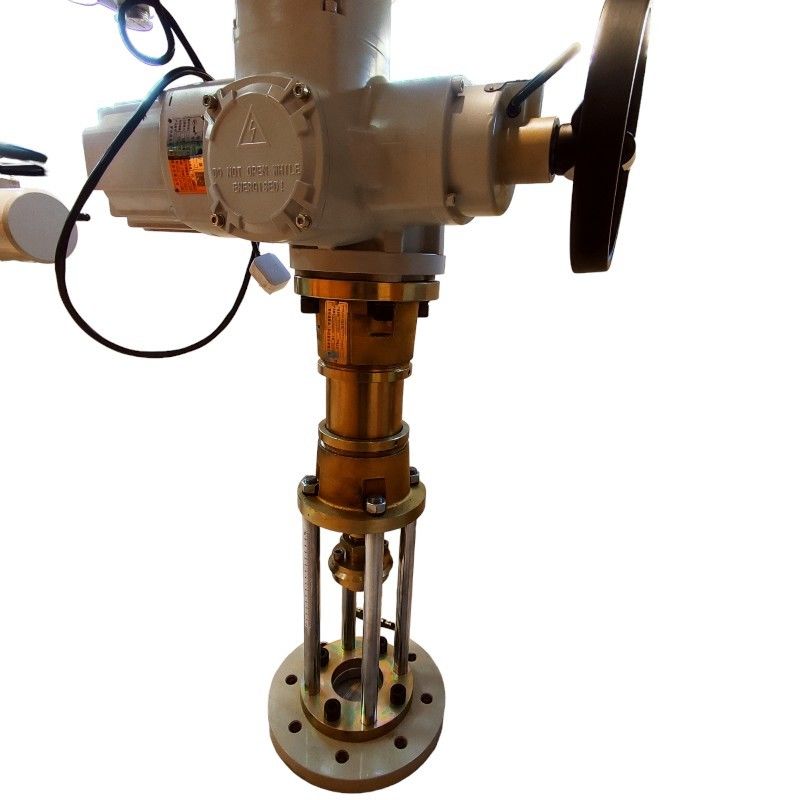
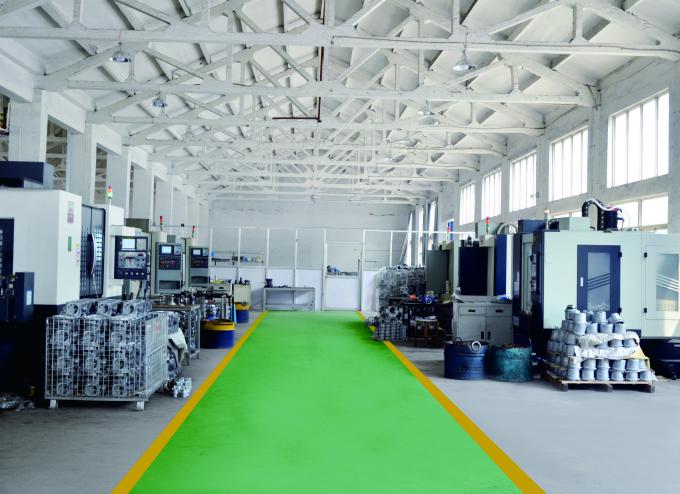
CHENGLEI's manufacturing base includes a 20,000 m² facility with more than 50 CNC machining centers, CNC lathes, and various inspection equipment. The company employs around 100 people, including a professional technical R&D team of 25 engineers and dozens of quality inspection personnel. Annual output is 120,000 units, and about 80% of production is exported to markets worldwide. The independently developed CL series valve electric actuators are applied in industries such as Oil & Gas, Water & Power, and Chemical, Process & Industrial.
Frequently Asked Questions
1. What do CT4 and BT4 mean for explosion-proof electric actuators, and which standards apply?
Explosion-proof electric actuators are standardized under IEC 60079-0 (General Requirements) and IEC 60079-1 (Flameproof Enclosures 'd'). They are classified into Gas Groups IIA, IIB, and IIC and Temperature Classes T1 to T6; Group IIC is required for hydrogen environments. In common procurement shorthand, BT4 denotes Gas Group IIB with Temperature Class T4, while CT4 denotes Gas Group IIC with Temperature Class T4. CHENGLEI requires national explosion-proof certificates (such as Ex d or Ex e) and 3C certification for actuators used in explosion-proof areas.
2. What capabilities distinguish an intelligent electric actuator from a conventional electric actuator?
CHENGLEI intelligent electric actuators add non-invasive commissioning, self-diagnosis with fault warnings, and fieldbus communication (Profinet, Modbus, Profibus). They provide absolute encoder position feedback, continuous torque monitoring, anti-seizure protection, and an adjustable dead zone of 0.5% to 5%. The control unit can be separated from the actuator body (split type) for vibration, high-temperature, or high-altitude applications. Documented performance includes IP68 (submerged for 48 hours), an operating range of -40°C to +70°C extendable to -60°C, lifespan of 30,000 or more operations without maintenance (depending on operating conditions), and MTBF above 50,000 hours.
3. Is the higher initial price of an intelligent electric actuator justified?
Initial procurement cost is approximately 1.5 to 2.5 times that of a traditional model, depending on functionality. The offset comes from lifecycle savings: bus communication reduces cables, trays, and IO cards, cutting total installation cost by 20–40%; torque output on demand reduces energy consumption by 15–30%; standby power in bus mode is below 5 W; and self-diagnosis lowers maintenance frequency. For plants with DCS/PLC integration, continuous processes, or harsh environments, the intelligent class typically has a lower total lifecycle cost. For simple standalone on/off valves without fieldbus, a conventional unit may remain the economical choice.
4. Can buyers request a sample or pilot unit before full procurement?
Buyers who need to validate performance before full procurement can contact the CHENGLEI sales team to discuss a sample or pilot unit. For non-standard working conditions such as high temperature or explosion-proof areas, the requested specification is reviewed by sales, technical, and production departments before confirmation. The company brochure, which summarizes the product portfolio and manufacturing capabilities, is available for download at https://cdn.socialarks.com/sbsp/24554/common/2026/0403/69cf860f86473.pdf.
5. What lead time and customization options should be confirmed for intelligent electric actuator orders?
CHENGLEI's factory produces up to 120,000 units per year with a 25-engineer R&D team and more than 50 CNC machining centers. Lead time depends on the specific configuration, order volume, and options such as a split-type control unit, explosion-proof certification, or a -60°C low-temperature build, so it should be confirmed against the exact specification. For a current quotation and production schedule, contact Mr. Gui Jing via WhatsApp at +8613401325958 (also the direct phone number) or email terry.gui@cz-chenglei.com.
Conclusion: Choose by Lifecycle Cost, Control Architecture, and Environment
The intelligent-versus-conventional decision in electric valve actuation comes down to three inputs: the compliance class of the site, the control architecture of the plant, and the operating environment of the valve. On documented parameters, the CHENGLEI intelligent electric actuator class offers fieldbus communication, non-invasive commissioning, self-diagnosis, IP68 protection, and a -40°C to +70°C operating range extendable to -60°C, at an initial cost of approximately 1.5–2.5 times that of a conventional model, offset by 20–40% installation cost savings and 15–30% energy savings. Where none of these capabilities are needed, a conventional actuator remains a valid choice. Where they are needed, the lifecycle calculation favors the intelligent class.
CHENGLEI, established in 2016 in Changzhou, China, manufactures electric part-turn, multi-turn, linear, and explosion-proof actuators, with about 80% of production exported globally. Procurement teams at the decision stage can obtain a specification-matched quotation directly from the manufacturer.
Get a Specification-Matched Electric Actuator Quotation
Changzhou Chenglei Valve Technology Co., Ltd. — manufacturer of intelligent electric actuators for industrial valve control.
- Website: www.electricvalvesactuators.com
- Contact: Mr. Gui Jing
- WhatsApp / Phone: +8613401325958
- Email: terry.gui@cz-chenglei.com
- Company brochure: Download PDF
Have Questions or Need More Details?
Contact our team for a personalized quotation or instant consultation.
Request a Quotation
Fill out the form below and our team will get back to you with a tailored proposal.
WhatsApp Direct Chat
Prefer to chat in real-time? Message us on WhatsApp for instant assistance & quick answers.
- Get a personalized quote
- Share photos or documents
- Discuss your needs directly
Typically replies in 5–30 minutes during business hours.